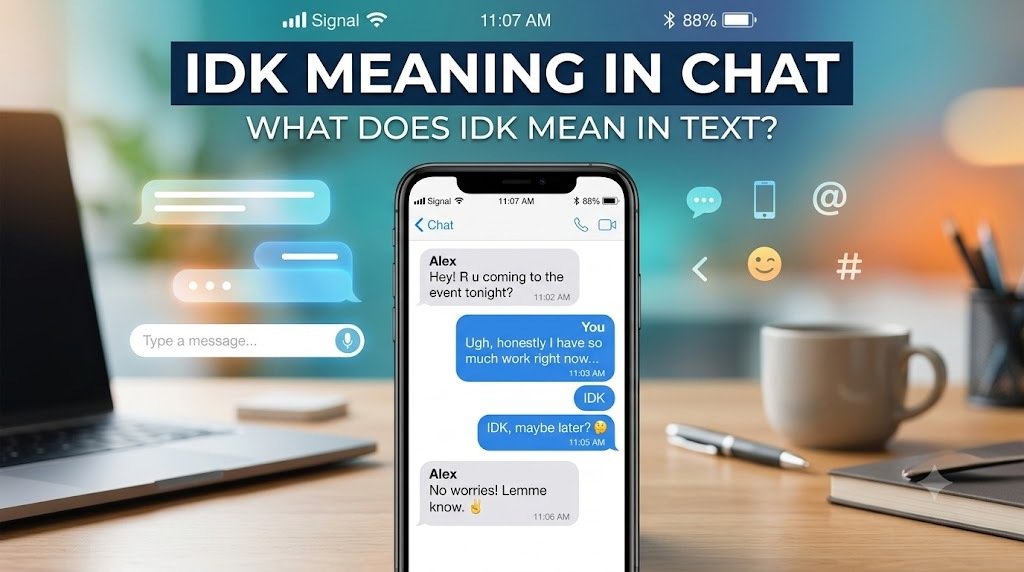
IDK Meaning in Chat: What Does IDK Mean in Texting?
If you have ever received a message that simply says “IDK”, you may have wondered what the person actually means. The good news is that the IDK meaning in chat is usually simple: “I don’t know.” It is a popular internet abbreviation used in texting, social media, online conversations, and everyday digital communication.
People use IDK when they do not know the answer to a question, are uncertain about something, or simply do not want to give a detailed response. Depending on the conversation, however, an IDK message can sometimes communicate more than a simple lack of knowledge. It may show uncertainty, confusion, hesitation, or even a desire to avoid answering a particular question.
For example, if someone asks, “What time are you coming?” and you reply, “IDK,” you probably mean that you are not sure yet. But if someone asks, “Do you like me?” and the answer is “IDK,” the meaning may be more complicated. In that situation, the person could genuinely be confused about their feelings, or they might not feel comfortable giving a direct answer.
In this guide, we will explore the IDK meaning in chat in detail, including what IDK means from a girl, what it means from a guy, how it can be used in romantic conversations, and how you can respond when someone sends you “IDK.”
What Does IDK Mean in Chat?
The IDK meaning in chat is “I don’t know.”
IDK is an informal abbreviation commonly used in text messages and online conversations. Instead of typing the complete phrase “I don’t know,” people often type the shorter version, “IDK,” because it is quicker and more convenient.
The abbreviation is especially common in casual conversations between friends, family members, classmates, coworkers, and people who communicate regularly through messaging apps.
Here are a few simple examples:
Person A: What time does the movie start?
Person B: IDK.
In this conversation, Person B simply means, “I don’t know.”
Another example:
Person A: Are you going to the party tonight?
Person B: IDK yet.
Here, the person is uncertain about whether they will attend the party.
The exact IDK meaning in chat can depend on the context. Sometimes it genuinely means that someone does not have the information. In other situations, it can express uncertainty or hesitation.
What Is the Full Meaning of IDK?
The full meaning of IDK is “I don’t know.”
It is an abbreviation created from the first letters of the words:
I = I
D = Don’t
K = Know
When combined, these letters form IDK.
The abbreviation is generally written in uppercase as IDK, but it is also common to see it written as idk in casual messages. Both forms usually have the same meaning.
For example:
“I don’t know what happened.”
can become:
“IDK what happened.”
Or:
“I don’t know if I can come.”
can become:
“IDK if I can come.”
There is no major difference in meaning between IDK and “I don’t know.” The main difference is the level of formality. “I don’t know” is appropriate in almost any situation, while IDK is generally associated with casual digital communication.
IDK Means “I Don’t Know”
When someone uses IDK, the most straightforward interpretation is that they do not know something.
Imagine asking your friend:
You: Who is coming to the event?
Friend: IDK.
Your friend is simply saying that they do not have that information.
Similarly:
You: What happened to Sarah?
Friend: IDK. I haven’t talked to her today.
In this example, IDK clearly means “I don’t know.”
However, people sometimes use IDK in ways that go beyond a simple lack of information.
For example:
You: Do you think he’ll come back?
Them: IDK.
This response could mean the person genuinely has no idea. It could also indicate uncertainty about the situation.
That is why understanding the IDK meaning in chat requires looking at the entire conversation rather than interpreting the abbreviation by itself.
IDK Meaning in Chat From a Girl
If a girl sends you “IDK,” you might wonder whether it has a special meaning. In most cases, the basic meaning remains “I don’t know.” However, the context of the conversation can influence what she is trying to communicate.
For example, if you ask:
“What are you doing later?”
and she replies:
“IDK yet.”
She may genuinely be unsure about her plans.
If you ask:
“Do you want to go out this weekend?”
and she says:
“IDK, maybe.”
This could mean she is uncertain about her availability or is not ready to commit to a plan.
The meaning can become more nuanced in personal or romantic conversations.
For example:
You: Do you actually like me?
Her: IDK.
This response does not necessarily mean that she dislikes you. She could be confused about her feelings, uncomfortable answering directly, or simply unsure about how she feels.
The important thing is not to assume that IDK meaning in chat from a girl always indicates a hidden romantic message. The meaning depends on her personality, the topic, the previous conversation, and the relationship between you.
If she frequently responds with short messages like “IDK,” it may simply be her texting style. Some people naturally communicate with brief responses, while others prefer longer conversations.
IDK Meaning in Chat From a Guy
The IDK meaning in chat from a guy is generally the same as from anyone else: “I don’t know.”
However, the context can change the message’s emotional meaning.
Suppose you ask a guy:
“Are you coming with us tomorrow?”
He replies:
“IDK yet.”
He may simply be uncertain about his schedule.
If you ask:
“What do you want to eat?”
and he says:
“IDK, you choose.”
In this case, he may not have a preference and is leaving the decision to you.
In a more personal conversation, however, IDK may communicate uncertainty.
For example:
You: Where do you think this relationship is going?
Him: IDK.
This could mean he is uncertain about the future of the relationship. But it could also mean that he has not thought about it or does not know how to answer.
Therefore, the IDK meaning in chat from a guy should not automatically be interpreted as disinterest, rejection, or a hidden message. Pay attention to the conversation as a whole.
His other messages, behavior, response time, and willingness to continue the conversation may provide more useful information than the word “IDK” alone.
IDK Meaning in Love and Relationships
The IDK meaning in love can be more complicated because emotions are involved.
When people are talking about relationships, dating, or romantic feelings, “IDK” may indicate uncertainty.
For example:
You: Do you think we should start dating?
Them: IDK. I’m still thinking about it.
Here, the person is clearly uncertain and may need more time.
Another example:
You: Do you still have feelings for me?
Them: IDK.
This could suggest emotional confusion. The person may not fully understand their own feelings, or they may not be ready to discuss them.
Sometimes, people use IDK because they want to avoid making a definite statement. They might not want to say “yes” or “no” because they are unsure about the consequences of their answer.
However, it is important not to overanalyze every “IDK” message in a romantic conversation.
If someone says:
“IDK 😂”
in response to a lighthearted question, they may simply be joking or being playful.
On the other hand, if someone says:
“IDK…”
during a serious conversation about your relationship, the same abbreviation could indicate uncertainty or emotional hesitation.
The punctuation, emojis, previous messages, and overall tone can all influence the meaning.
Does IDK Mean Someone Is Not Interested?
Not necessarily.
One of the biggest mistakes people make when interpreting texting abbreviations is assuming that every short response has a hidden meaning.
If someone says “IDK,” it does not automatically mean they are uninterested.
For example:
“IDK, I’m really tired today.”
This person may simply be exhausted.
Or:
“IDK, let me check my schedule.”
This person is probably interested in answering but does not have the information immediately available.
However, if someone consistently responds with:
“IDK.”
“K.”
“Whatever.”
and never contributes to the conversation, you may reasonably feel that they are not very engaged.
In that case, the pattern of communication matters more than one abbreviation.
The IDK meaning in chat should therefore be interpreted based on context and communication patterns rather than one message alone.
Why Do People Use IDK in Texting?
There are several reasons people use IDK instead of typing “I don’t know.”
The first reason is convenience. Typing three letters is faster than typing the entire phrase.
The second reason is casual communication. Online conversations often use abbreviations because they make messages feel relaxed and informal.
The third reason is texting habits. People who frequently use abbreviations such as LOL, OMG, BTW, TBH, and IDK may naturally include them in everyday messages.
Another reason is that IDK can sometimes make a response sound less serious.
Compare these two responses:
“I don’t know.”
“IDK lol.”
The first may sound more direct or serious, while the second feels more casual.
Of course, tone depends on the person and the situation. A simple abbreviation can sound friendly in one conversation and dismissive in another.
IDK Meaning in Different Chat Situations
The meaning of IDK can change slightly depending on what someone is discussing.
When Someone Doesn’t Know the Answer
This is the most common use.
You: What is the answer to question five?
Friend: IDK.
Here, IDK simply means the person does not know the answer.
When Someone Is Unsure
IDK can also communicate uncertainty.
You: Are you going to travel this summer?
Them: IDK yet.
This means they have not decided.
When Someone Is Thinking
Sometimes IDK means the person needs time to consider something.
You: Do you want to move to another city?
Them: IDK. I need to think about it.
The person is uncertain and may not have reached a decision.
When Someone Doesn’t Want to Give Details
In some conversations, IDK can be used as a short way to avoid explaining something.
For example:
You: Why were you talking to him?
Them: IDK.
Depending on the situation, this might mean they genuinely do not know why, or they may simply not want to discuss it.
When Someone Is Being Casual
Sometimes IDK is used without much thought.
You: What should we order?
Them: IDK, anything is fine.
In this case, the person may not have a preference.
IDK Meaning in Gali or Slang
If you searched for IDK meaning in gali, it is important to clarify that IDK itself is not normally a swear word or abusive expression.
In standard internet slang and texting, IDK means “I don’t know.”
The word “gali” can refer to abusive or offensive language in some South Asian contexts, so people may be searching to find out whether IDK has a slang or offensive interpretation.
In general, it does not.
However, online slang can vary between communities, languages, and regions. A person may use IDK in a sentence that contains slang or offensive language, but that does not change the standard meaning of IDK itself.
For example:
“IDK bro.”
simply means:
“I don’t know, bro.”
The word IDK remains an abbreviation for “I don’t know.”
If you encountered IDK in a specific sentence that appears to have a different meaning, the surrounding words and language should be considered before interpreting it.
Examples of IDK in Text Messages
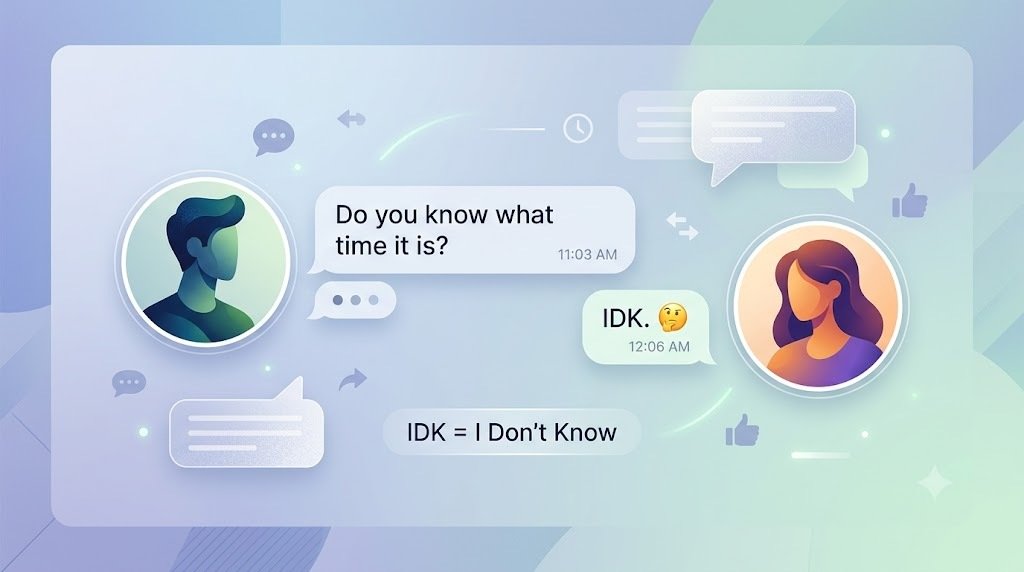
Here are some common examples that show how people use IDK in everyday conversations.
Example 1
Person A: What time is the meeting?
Person B: IDK. Ask John.
Meaning: Person B does not know the meeting time.
Example 2
Person A: Are you free tomorrow?
Person B: IDK yet.
Meaning: Person B is uncertain about their schedule.
Example 3
Person A: What do you want for dinner?
Person B: IDK. You pick.
Meaning: Person B has no particular preference.
Example 4
Person A: Do you think she likes me?
Person B: IDK 😂
Meaning: Person B does not know and may be responding casually or humorously.
Example 5
Person A: Are you still mad at me?
Person B: IDK.
Meaning: This could indicate emotional uncertainty or difficulty expressing feelings.
Example 6
Person A: Do you want to go out with me?
Person B: IDK, maybe.
Meaning: The person is uncertain and has not given a definite yes or no.
These examples show why context matters when understanding the IDK meaning in chat.
Is IDK Rude in Chat?
IDK is not inherently rude.
However, the way it is used can sometimes make a message seem dismissive.
For example:
“IDK.”
may sound short or uninterested if someone has asked an important question.
But:
“IDK honestly, I’ll check and let you know.”
sounds more helpful and engaged.
The difference is not necessarily the abbreviation itself. It is the surrounding language and tone.
If you want to sound polite, you can expand your response:
“I’m not sure, but I’ll find out.”
or:
“I don’t know yet, but I’ll let you know when I do.”
These responses communicate uncertainty while showing that you are willing to help.
How to Reply When Someone Says IDK
Your response should depend on what the person is talking about.
If someone says:
“IDK.”
you could reply:
“No worries.”
If you need more information, you can say:
“Can you find out?”
If they are uncertain about a decision, you might say:
“Take your time and let me know.”
If the conversation is romantic, you may want to ask a gentle follow-up question.
For example:
You: Do you still like me?
Them: IDK.
You could respond:
“That’s okay. You can take some time to figure out how you feel.”
This approach is usually better than immediately assuming what the person means.
IDK vs. I Don’t Know
IDK and “I don’t know” have the same basic meaning, but they are used in different communication styles.
IDK is informal and common in texting, social media, chats, and casual conversations.
I don’t know is more complete and can be used in both casual and formal communication.
For example, you might text a friend:
“IDK what we’re doing tonight.”
But in a professional email, you would probably write:
“I’m not sure what the plan is for tonight.”
The abbreviation is best suited for informal digital communication.
IDK vs. IDC
IDK and IDC are sometimes confused because they look similar.
IDK means “I don’t know.”
IDC means “I don’t care.”
These abbreviations have very different meanings.
For example:
“IDK where he went.”
means:
“I don’t know where he went.”
But:
“IDC where he went.”
means:
“I don’t care where he went.”
The first expresses a lack of knowledge, while the second expresses a lack of concern or interest.
Because IDC can sound harsh or dismissive, it is important not to confuse it with IDK.
Is IDK a Slang Word?
IDK is generally considered an internet abbreviation or texting shorthand rather than traditional slang.
It became popular through digital communication and is now widely recognized by people who use messaging apps and social media.
You may see IDK in text messages, social media comments, online forums, gaming chats, and direct messages.
It is particularly common in informal conversations where people prefer short and quick responses.
What Does IDK Mean on Social Media?
On social media, IDK usually means exactly the same thing: “I don’t know.”
Someone might use it in a comment, direct message, caption, or reply.
For example:
“IDK why everyone is talking about this.”
This means:
“I don’t know why everyone is talking about this.”
You might also see variations such as:
IDK lol
IDK tbh
IDK anymore
IDK honestly
These combinations add additional context.
For example, “IDK tbh” means “I don’t know, to be honest.”
“IDK anymore” can suggest that someone used to know or have an opinion but is now uncertain.
Does IDK Always Mean the Same Thing?
The basic definition of IDK remains “I don’t know,” but the intended meaning can vary.
Someone might use it to express:
Uncertainty.
Confusion.
Lack of information.
Indecision.
Hesitation.
A casual response.
Avoidance of a question.
The only reliable way to understand which meaning applies is to consider the context.
If someone asks you a factual question and receives an IDK response, the meaning is probably straightforward.
If someone asks about feelings or relationships, however, IDK may communicate emotional uncertainty.
How to Understand IDK in a Conversation
When trying to interpret an IDK message, look at the entire conversation.
Consider what question was asked immediately before the person responded.
Also consider the relationship between you and the other person. A close friend may use IDK casually, while a romantic partner may use it to express uncertainty about something more serious.
You should also pay attention to emojis and punctuation.
For example:
“IDK 😂”
may sound playful.
“IDK…”
may suggest hesitation.
“IDK!!!”
could express frustration, excitement, or strong uncertainty depending on the situation.
The words surrounding IDK are also important.
“IDK, let me check.”
shows that the person is willing to find an answer.
“IDK and I don’t care.”
has a very different tone.
Understanding the IDK meaning in chat is therefore about more than simply knowing the abbreviation. It is about interpreting the communication around it.
Frequently Asked Questions About IDK Meaning in Chat
IDK means “I don’t know.” It is a common abbreviation used in texting, messaging apps, social media, and other informal online conversations.
The full meaning of IDK is “I don’t know.” The letters come from the first letters of “I,” “Don’t,” and “Know.”
Yes. In most texting and online conversations, IDK directly means “I don’t know.”
When a girl says IDK, it usually means “I don’t know.” Depending on the context, it may also express uncertainty, hesitation, or confusion. It does not automatically have a romantic meaning.
The IDK meaning in chat from a guy is usually “I don’t know.” In some conversations, it may indicate that he is uncertain or does not want to give a definite answer.
In romantic conversations, IDK may indicate uncertainty about feelings, relationships, or future plans. However, the exact meaning depends on the situation.
IDK is not automatically rude. However, a very short “IDK” response can sometimes sound dismissive, especially during a serious conversation.
On social media, IDK generally means “I don’t know.” It is commonly used in comments, posts, direct messages, and replies.
IDK is commonly described as internet slang, texting shorthand, or an online abbreviation. It is widely used in informal digital communication.
You can respond based on the situation. Try “No worries,” “Let me know when you find out,” or ask a follow-up question if you need more information.
IDK means “I don’t know,” while IDC means “I don’t care.” They have completely different meanings and should not be confused.
In standard texting and internet communication, IDK means “I don’t know.” However, the emotional tone behind the message can vary depending on the conversation and context.
Final Thoughts on IDK Meaning in Chat
The IDK meaning in chat is simple: “I don’t know.” It is one of the most common abbreviations used in texting and online communication.
People use IDK when they lack information, feel uncertain, have not made a decision, or simply want to give a quick and casual response. The abbreviation can also appear in conversations about friendship, dating, love, and relationships, where the context may give it a deeper emotional meaning.
If a girl or guy sends you “IDK,” do not immediately assume that they are uninterested or hiding something. Look at the conversation, the question you asked, their tone, and their overall communication style.
In most everyday situations, IDK simply means “I don’t know.” When the conversation is more personal, however, it may also communicate uncertainty or hesitation. Understanding the context is the best way to determine what someone really means.
So, the next time you see “IDK” in a text message, you will know that it usually means “I don’t know”—but the exact intention behind those three letters depends on the conversation and the person using them.
If you’re interested in other common texting abbreviations, you can also learn about What Does WYA Meaning in Text?

Helping brands improve search visibility through expert guest posting, blogger outreach, quality backlink acquisition, and white-hat off-page SEO strategies that deliver results.