DTM Meaning in Text: What Does DTM Mean in Texting and Social Media?
DTM Meaning in Text: Quick Answer
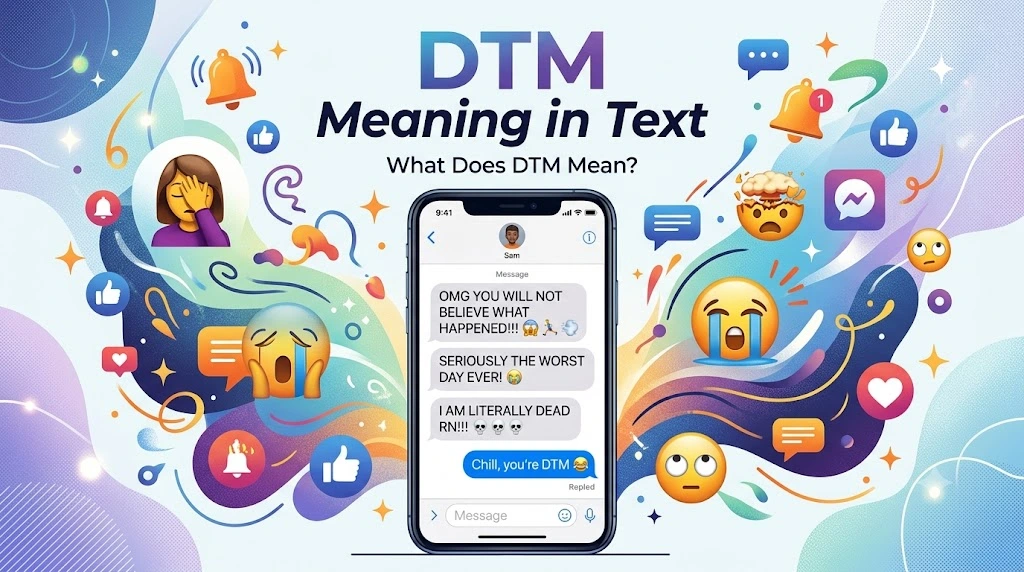
If you see DTM in a text message or on social media, it most commonly means “Doing Too Much.” People use this abbreviation when someone is overreacting, being overly dramatic, trying too hard, or taking a situation further than necessary.
For example, if your friend is making a big deal out of a small problem, you might say:
“You’re DTM 😂.”
In this context, you are saying:
“You’re doing too much.”
The exact tone can vary depending on the conversation. Between friends, DTM is often used jokingly or playfully. In other situations, it can be a genuine criticism of someone’s behavior.
So, if you’re searching for the DTM meaning in text, the most common answer is “Doing Too Much.”
What Does DTM Mean in Text?
The most common DTM meaning in text is “Doing Too Much.”
This informal abbreviation is used when someone thinks another person is being excessive or going beyond what is necessary. The person might be overreacting to a situation, putting in unnecessary effort, making something more complicated than it needs to be, or behaving in an overly dramatic way.
For example, imagine that your friend becomes extremely upset because someone did not reply to their message for 10 minutes. You might say:
“Why are you DTM? It’s only been 10 minutes.”
Here, DTM means that your friend is doing too much or overreacting to the situation.
The expression can be serious or humorous depending on the context. Close friends may use it to tease each other, while someone else may use it to express genuine annoyance.
DTM Meaning: Doing Too Much
The phrase “Doing Too Much” is common in casual conversations and online communication. It describes behavior that seems excessive, unnecessary, exaggerated, or over-the-top.
Someone might be called DTM if they are:
Overreacting to a minor issue.
Trying too hard to impress someone.
Making a simple situation unnecessarily complicated.
Being overly dramatic.
Spending more money than necessary.
Sending too many messages.
Taking a joke too seriously.
Putting excessive effort into something simple.
For example, if someone buys 20 outfits for a three-day trip, a friend might jokingly say:
“You’re DTM 😂.”
The speaker does not necessarily mean anything seriously negative. They are simply pointing out that their friend may have gone a little overboard.
DTM Meaning in Texting
In texting, DTM is a convenient way to shorten the phrase “Doing Too Much.” Like many other texting abbreviations, it allows people to communicate quickly without typing the entire phrase.
You might see DTM used in messages such as:
“Why are you DTM?”
“You’re really DTM right now.”
“I think you’re DTM with this.”
“Stop DTM. It’s not that serious.”
“Girl, you’re DTM 😂.”
The meaning is usually clear from the surrounding conversation. If someone says “You’re DTM,” they are generally suggesting that your behavior, reaction, or effort is excessive.
The tone is especially important. A laughing emoji or a playful conversation often indicates that DTM is being used as a joke.
DTM Meaning on Social Media
The DTM meaning is also commonly seen on social media. People use the abbreviation in comments, captions, direct messages, and posts.
You may see DTM on platforms such as TikTok, Instagram, Snapchat, Facebook, and X.
For example, someone might post a video of a person having an exaggerated reaction and someone comments:
“He’s DTM 😂.”
This means the person is doing too much or acting overly dramatic.
Another example is:
“Why are y’all DTM in the comments?”
This means the person thinks other users are taking the discussion too far or becoming unnecessarily dramatic.
On social media, DTM is often used in a humorous way. It can be a quick and casual way to point out that someone’s behavior is excessive.
If you’re interested in learning more about social media slang, understanding abbreviations like DTM can make online conversations much easier to follow.
Examples of DTM in Text Messages
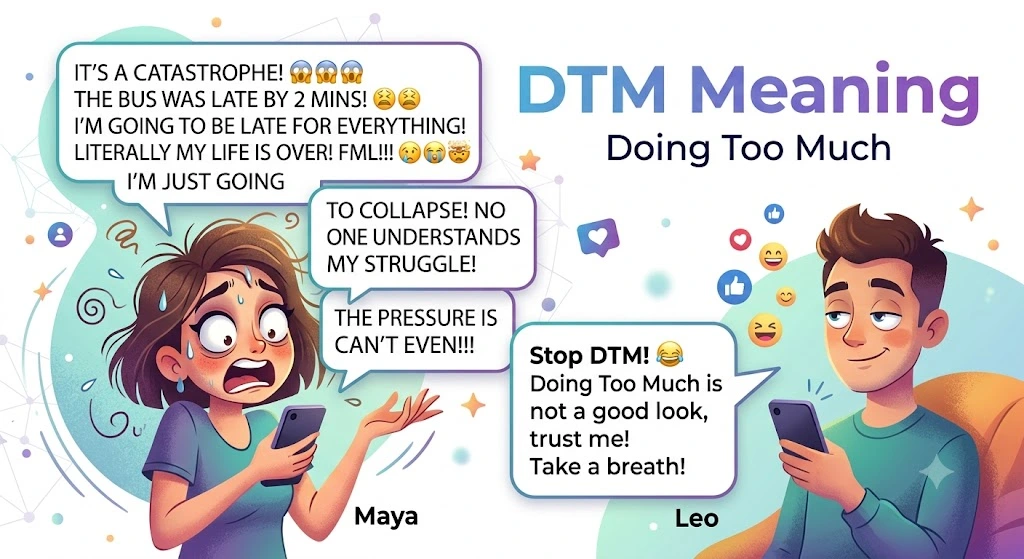
The best way to understand the DTM meaning in text is to look at how people use it in everyday conversations.
Example 1: Overpacking
Friend 1: I packed 20 outfits for my three-day vacation.
Friend 2: You’re DTM 😂.
Here, the second friend thinks the first person packed far more clothes than necessary.
Example 2: Overreacting
Friend 1: She didn’t like my Instagram post, so I’m never talking to her again.
Friend 2: You’re DTM.
In this example, the second person believes the reaction is excessive.
Example 3: Sending Too Many Messages
Person 1: I called him five times and sent him 10 messages because he didn’t reply.
Person 2: Bro, you’re DTM.
Here, the person is saying that calling and messaging so many times is unnecessary.
Example 4: Going Overboard
Friend 1: I decorated the entire house for my cat’s birthday.
Friend 2: Okay, you’re DTM 😂.
This is probably a playful comment about someone putting too much effort into something.
Example 5: Taking Something Too Seriously
Person 1: Why are you arguing with everyone over a joke?
Person 2: Because they were wrong!
Person 1: You’re DTM.
In this situation, the speaker thinks the other person is taking the situation too seriously.
Is DTM a Positive or Negative Expression?
The DTM meaning can be either playful or negative depending on the context.
Among close friends, saying “You’re DTM” is often harmless teasing. It may simply mean that someone is being extra or going overboard.
For example:
“You bought a whole new wardrobe for one party? You’re DTM 😂.”
This is probably a playful comment.
However, DTM can also be used as criticism.
For example:
“You don’t need to argue with everyone. You’re DTM.”
Here, the speaker is genuinely telling the other person that their behavior is excessive.
The tone of voice cannot be heard in a text message, so emojis and surrounding messages can provide useful clues. “You’re DTM 😂” usually sounds more playful than “You’re DTM.”
DTM vs. Doing Too Much
There is no major difference between DTM and “Doing Too Much.” DTM is simply the abbreviated form of the phrase.
The difference is mainly in communication style.
“You’re doing too much.” is the complete phrase.
“You’re DTM.” is the shorter, more casual version.
People generally use DTM in informal conversations because it is faster to type and fits naturally into texting and social media communication.
Like other NFS Meaning in Text, DTM is generally intended for casual communication rather than formal writing.
Why Do People Say DTM?
People use DTM when they believe someone’s behavior is excessive or unnecessary.
A person might be DTM if they are making a big deal out of a small problem, trying too hard to impress someone, overreacting, or putting too much effort into something.
For example:
“You blocked him because he didn’t like your post? You’re DTM.”
The speaker believes the reaction is too extreme for the situation.
Another example could be:
“You spent six hours planning a surprise for a five-minute event. You’re DTM.”
Here, DTM means the person has put more effort into something than was necessary.
“Like other forms of internet slang, DTM allows people to communicate an idea quickly without typing the complete phrase.”
The phrase is often used because it is short, expressive, and easy to understand in casual conversations.
What Does “You’re DTM” Mean?
When someone says “You’re DTM,” they usually mean:
“You’re doing too much.”
The phrase can mean that someone is:
Overreacting.
Being dramatic.
Trying too hard.
Taking something too seriously.
Going beyond what is necessary.
Making a simple situation more complicated.
For example:
“You bought a new phone just because your friend bought one? You’re DTM.”
The speaker is suggesting that the action was excessive or unnecessary.
However, the exact meaning depends on the situation and the relationship between the people involved.
What Does “Stop DTM” Mean?
“Stop DTM” usually means “Stop doing too much.”
Someone might use this phrase when they believe another person is overreacting, being dramatic, or making a situation unnecessarily complicated.
For example:
“Stop DTM. It’s not that serious.”
This means the person should stop exaggerating the situation and calm down.
Similarly, if someone asks:
“Why are you DTM?”
They are essentially asking:
“Why are you doing too much?”
DTM Meaning in Different Situations
The meaning of DTM is strongly influenced by context.
If someone says “You’re DTM” after you have an exaggerated reaction, they probably mean that you are overreacting.
If they say it after you spend a large amount of money, they may mean that you are being excessive with your spending.
If they say it after you send multiple messages to someone who has not responded, they may mean that you are trying too hard to get their attention.
If they say it after you create an elaborate plan for a simple event, they may simply be joking about how much effort you are putting into it.
In all of these situations, the basic idea remains the same: you are doing more than necessary.
How to Respond When Someone Says “DTM”
How you respond to DTM depends on the tone of the conversation.
If someone is joking with you, you can respond playfully:
“Maybe just a little 😂.”
“I can’t help it!”
“Let me live 😂.”
“And I’m not stopping anytime soon.”
If someone is genuinely criticizing you, you might respond:
“What do you mean?”
“I don’t think I’m doing too much.”
“Maybe, but I had my reasons.”
If you are unsure what they mean, the simplest response is:
“How am I doing too much?”
This gives the other person an opportunity to explain what they mean.
Other Possible Meanings of DTM
Although “Doing Too Much” is a common meaning of DTM in casual texting, abbreviations can have different meanings depending on the context.
DTM may refer to other phrases, organizations, technical terms, or names in different fields.
For example, a person discussing business, technology, transportation, or another specialized topic might use DTM to mean something completely different.
This is why context is important.
If you see DTM in a casual conversation about someone’s behavior, reaction, or effort, “Doing Too Much” is likely the intended meaning.
If DTM appears in a professional or technical discussion, you should consider other possible interpretations.
Is DTM Appropriate for Formal Communication?
DTM is generally considered informal texting and internet slang.
If you want to explore how English words and expressions are documented and defined, you can consult an authoritative English language reference such as the Oxford English Dictionary.
Because of this, it is usually not appropriate for formal emails, professional documents, academic assignments, or official communication.
For example, instead of writing:
“You’re DTM.”
in a professional conversation, you could say:
“I think you’re putting more effort into this than necessary.”
The full phrase is clearer and more appropriate for formal situations.
DTM is best reserved for casual conversations with friends, family, or people who are comfortable with informal internet language.
DTM Meaning in a Nutshell
The most common DTM meaning in text is “Doing Too Much.”
People use DTM when they think someone is being excessive, overreacting, acting dramatically, trying too hard, or putting unnecessary effort into something.
For example:
“Why are you DTM?” means “Why are you doing too much?”
“You’re DTM.” means “You’re doing too much.”
“Stop DTM.” means “Stop doing too much.”
The expression can be playful or serious, so always consider the context before deciding how the person intended it.
Frequently Asked Questions About DTM Meaning
What does DTM mean in text?
The most common DTM meaning in text is “Doing Too Much.” It is used when someone is overreacting, being dramatic, or going beyond what is necessary.
What does DTM stand for in texting?
In casual texting, DTM usually stands for “Doing Too Much.” It is an informal abbreviation commonly used in text messages and social media conversations.
What does “You’re DTM” mean?
“You’re DTM” means “You’re doing too much.” It can suggest that someone is overreacting, being excessive, or taking something too far.
What does “Stop DTM” mean?
“Stop DTM” means “Stop doing too much.” Someone may use this phrase when they think another person is overreacting or making a situation unnecessarily complicated.
Is DTM slang?
Yes. DTM is commonly used as informal texting and internet slang. It is generally used in casual conversations rather than formal communication.
Is DTM always negative?
No. DTM is not always negative. Friends often use it jokingly to tease each other, while in other situations it can be used as genuine criticism.
What does DTM mean on social media?
On social media, DTM usually means “Doing Too Much.” People may use it in comments, captions, posts, and direct messages to describe someone who is acting excessively.
How do I respond to someone saying DTM?
If the person is joking, you can respond playfully with something like “Maybe a little 😂.” If they are serious, you can ask what they mean or explain why you acted that way.
Can DTM have other meanings?
Yes. DTM can have different meanings in technical, professional, or specialized contexts. However, in casual texting and social media, “Doing Too Much” is a common interpretation.
What is the difference between DTM and “Doing Too Much”?
There is no significant difference. DTM is simply a shortened version of “Doing Too Much.” The abbreviation is more casual and convenient for texting.
Final Thoughts on DTM Meaning
Understanding texting slang can make online conversations much easier to follow. If you were searching for the DTM meaning in text, the most common answer is “Doing Too Much.”
People use DTM when they feel someone is overreacting, being overly dramatic, trying too hard, or putting unnecessary effort into a situation.
The phrase can be playful between friends or more critical depending on the context. If someone says “You’re DTM” or “Stop DTM,” they are usually telling you that they think you are doing more than necessary.
As with most texting abbreviations, context is important. However, when DTM appears in a casual conversation about someone’s behavior or reaction, “Doing Too Much” is usually the meaning.

Helping brands improve search visibility through expert guest posting, blogger outreach, quality backlink acquisition, and white-hat off-page SEO strategies that deliver results.