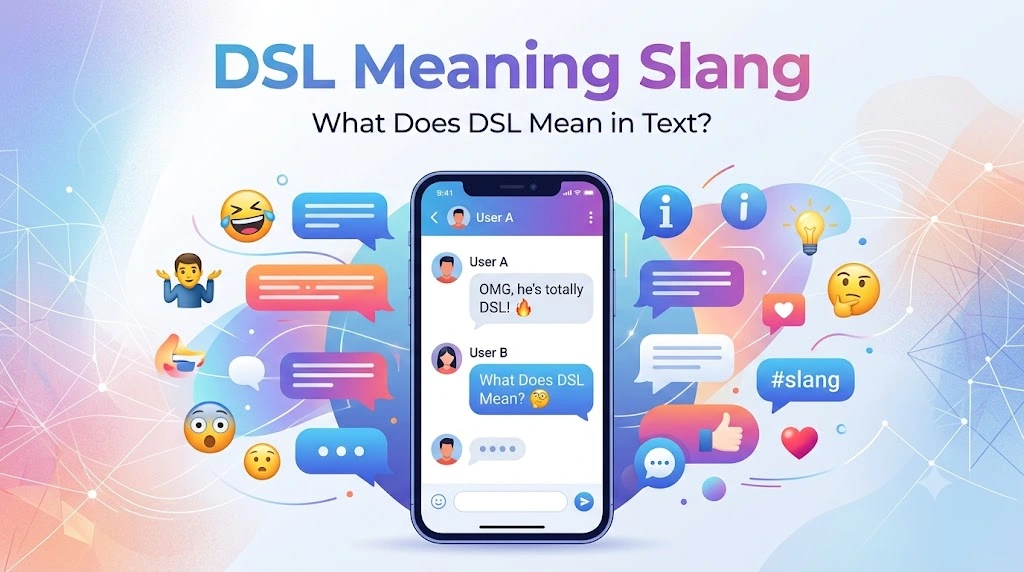
DSL Meaning Slang: What Does DSL Mean in Text and Online?
DSL Meaning Slang: Quick Answer
If you have seen DSL in a text message, social media comment, meme, or online conversation, you may be wondering what it means.
In modern internet slang, DSL is commonly used as a vulgar abbreviation referring to attractive, full, or prominent lips. The acronym comes from a sexually explicit phrase, so it is generally considered adult, suggestive, or NSFW slang. It is often used as a comment about someone’s appearance and may be intended as a flirtatious compliment, joke, or crude remark depending on the context.
However, DSL meaning can change completely depending on where you see the term. In technology, DSL commonly means Digital Subscriber Line, a type of internet connection. In French texting, lowercase dsl is often used as a shortened form of désolé, meaning “sorry.”
Therefore, the context is extremely important when interpreting DSL meaning.
What Does DSL Mean in Slang?
When used as internet or social media slang, DSL commonly refers to a person’s lips, particularly when they are considered full, large, or attractive.
The slang term has a vulgar sexual origin, which is why it is often used in adult humor, memes, flirtatious conversations, and comments about someone’s physical appearance.
For example, if someone comments:
“She has DSL.”
They may be making a sexually suggestive comment about the person’s lips.
The expression can also appear in a joking or humorous way. However, because of its explicit origin, it is not considered appropriate for every audience or situation.
If you encounter DSL meaning slang while browsing social media, the surrounding conversation can help you determine whether the person is using it as a joke, a compliment, or a more direct sexual reference.
What Does DSL Mean in Text?
The DSL meaning in text depends on the context.
If you are chatting casually with someone and the conversation involves appearance, attraction, or physical features, DSL may be referring to attractive or full lips.
For example:
Person 1: “Did you see her new photo?”
Person 2: “Yeah, she has DSL.”
In this context, the person is making a comment about her lips.
However, if you see DSL in a technology conversation, it probably means Digital Subscriber Line, which is an internet connection technology.
For example:
“My DSL connection has been slow today.”
Here, DSL has nothing to do with slang or physical appearance. It refers to internet service.
This is why it is important not to assume that every use of DSL has the same meaning.
DSL Meaning in Social Media
The DSL meaning has become recognizable in internet culture because social media frequently uses abbreviations to communicate ideas quickly.
You may encounter DSL in comments, memes, captions, direct messages, and discussions about someone’s appearance.
The slang meaning is often associated with comments about lips. Depending on the situation, the term may be used as a compliment, a flirtatious comment, a joke, or a crude observation.
For example, someone might comment:
“Those DSLs though.”
The commenter is likely referring to the person’s lips.
However, the phrase can be interpreted differently depending on the relationship between the people involved. A close friend might use it jokingly, while a stranger using the same term could come across as inappropriate or objectifying.
Because of this, it is important to consider both the context and the audience before using DSL.
Is DSL a Compliment?
The answer depends on the person, the context, and the relationship between the people communicating.
In some online conversations, DSL is used to express attraction or compliment someone’s lips. In other situations, the same expression may feel crude, sexual, or disrespectful.
For example, a close friend might use the term jokingly in a private conversation. However, using it toward a stranger or posting it publicly under someone’s photo may be interpreted as inappropriate.
If you want to compliment someone’s appearance without using potentially offensive slang, a more respectful phrase such as “You have beautiful lips” or “Your smile looks great” is generally safer.
The key point is that DSL is not a universally appropriate compliment. Its explicit origin means that you should be careful about when and where you use it.
Is DSL Considered NSFW Slang?
Yes, the slang meaning of DSL is generally considered adult or NSFW because it comes from an explicit sexual phrase.
Although some people use the abbreviation casually or humorously, its underlying meaning is still sexual in nature.
This means you may see DSL in adult humor, memes, dating conversations, or flirtatious online discussions.
It is generally best to avoid using the slang meaning in professional environments, formal conversations, school-related communication, or situations where you do not know how the other person will interpret it.
If you are simply discussing the meaning of the term, however, explaining it in a factual and educational context is different from using it directly toward another person.
DSL Meaning in Different Contexts
One of the most important things to understand about DSL meaning is that the abbreviation has several unrelated definitions.
DSL as Internet Technology
In technology, DSL commonly stands for Digital Subscriber Line.
It is a family of technologies used to provide internet access through telephone lines. This meaning is completely unrelated to internet slang.
For example:
“We used to have DSL internet before switching to fiber.”
In this sentence, DSL refers to an internet connection rather than slang.
DSL as Internet Slang
In internet slang, DSL is commonly used as an abbreviation for a vulgar phrase referring to attractive or full lips.
This is the meaning you are most likely looking for if you encountered DSL in a meme, social media comment, or conversation about someone’s appearance.
DSL in French Texting
In French texting, lowercase dsl is commonly used as an abbreviation for désolé, which means “sorry.”
For example:
“Dsl, je suis en retard.”
This can be understood as:
“Sorry, I’m late.”
This is another reason context matters. Someone using dsl in a French-language conversation may have no connection to the English slang meaning at all.
DSL as a Technical or Professional Acronym
DSL can also represent specialized terms in different industries and fields. For example, it can refer to a domain-specific language in programming.
Therefore, if you encounter DSL in a technical document, software discussion, or programming conversation, the slang interpretation is probably not relevant.
How to Tell Which DSL Meaning Someone Means
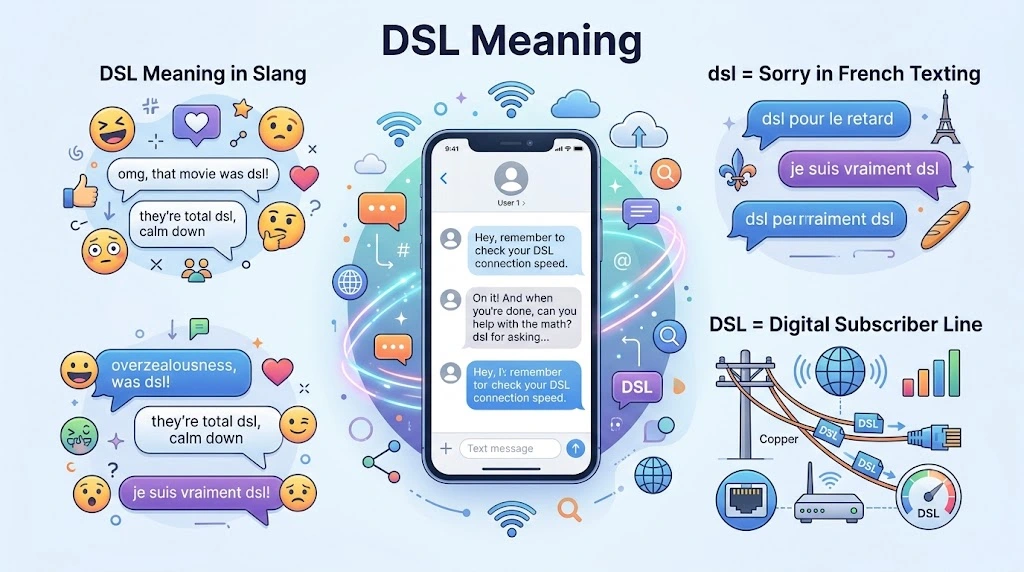
The easiest way to understand DSL meaning is to look at the words and topic surrounding it.
If the conversation is about someone’s appearance, attraction, lips, or a social media photo, the slang meaning may be intended.
If the conversation is about internet service, routers, broadband, or connection speeds, DSL probably means Digital Subscriber Line.
If the conversation is in French and involves an apology, dsl may mean désolé, or “sorry.”
If the discussion involves software development or programming, DSL may mean domain-specific language.
The same three letters can therefore have completely different meanings.
When in doubt, look at the full sentence rather than interpreting the abbreviation by itself.
Examples of DSL Used as Slang
Here are some examples that demonstrate how the slang term may appear in casual online conversations.
Example 1: Comment About Appearance
Person 1: “Did you see her latest picture?”
Person 2: “Yeah, she has DSL.”
The second person is making a suggestive comment about the person’s lips.
Example 2: Social Media Comment
Person 1: “Why are people commenting DSL under her video?”
Person 2: “They’re talking about her lips.”
Here, the term is being used as slang related to physical appearance.
Example 3: Flirtatious Conversation
Person 1: “You looked really good in that photo.”
Person 2: “Thanks 😂.”
Person 1: “The DSL is crazy.”
The comment is intended as a flirtatious or sexually suggestive remark.
Example 4: Technology Context
Person 1: “What kind of internet do you have?”
Person 2: “DSL.”
Here, DSL means Digital Subscriber Line, not slang.
Example 5: French Texting
Person 1: “Why didn’t you come?”
Person 2: “Dsl, j’étais occupé.”
Here, dsl means désolé, or “sorry,” in French texting.
These examples demonstrate why context is essential when interpreting DSL meaning.
What Does “DSLs” Mean?
You may sometimes see the plural form “DSLs” instead of DSL.
In slang conversations, this generally refers to multiple examples of the physical feature being discussed, usually someone’s lips.
For example:
“She has DSLs.”
The speaker is using the plural form of the slang expression.
However, the meaning can still depend on context. In a technical conversation, DSLs could refer to multiple DSL internet connections or multiple domain-specific languages.
How Should You Respond If Someone Says DSL?
Your response depends on the situation.
If someone uses DSL as a compliment or flirtatious comment and you are comfortable with the conversation, you can respond casually.
For example:
“Haha, thanks.”
“I’ll take that as a compliment.”
If you do not appreciate the comment, you can simply ignore it or make your boundaries clear.
For example:
“I’d rather not discuss my appearance like that.”
If you are unsure what someone means by DSL, you can ask:
“What do you mean by DSL?”
This is especially useful because the abbreviation has multiple meanings.
Should You Use DSL Slang?
Whether you should use DSL slang depends on the context.
Because the slang meaning has an explicit sexual origin, it is best reserved for situations where the participants understand the meaning and are comfortable with that type of language.
Avoid using it in professional emails, academic assignments, workplace communication, or formal conversations.
You should also be careful when commenting on strangers’ photos. Even if you intend the term as a compliment, the person receiving the comment may find it inappropriate or offensive.
When communicating with someone you do not know well, using neutral language is generally the safer option.
DSL Meaning vs. Other Texting Abbreviations
DSL is one of many abbreviations that can have multiple interpretations depending on context.
For example, texting abbreviations such as ATP, TTYL, SMH, OTP, OFC, FS, HMU, and TBH each have their own common meanings and usage patterns.
If you enjoy learning about texting slang, you can explore the ATP meaning in text to understand another common abbreviation.
You can also learn what TTYL means in text and explore other popular texting expressions.
The important thing to remember is that abbreviations are highly dependent on context. A term that has one meaning in a casual chat can have an entirely different meaning in technology, business, or another language.
Is DSL Appropriate for Formal Communication?
The slang meaning of DSL is generally not appropriate for formal communication.
You should avoid using the slang version in professional emails, workplace messages, academic assignments, business documents, and official communication.
The term has an explicit origin and can easily be misunderstood or considered offensive.
If you need to discuss the word itself, you can explain its meaning in a neutral and educational way. However, using the abbreviation to comment on someone’s physical appearance is generally best avoided in formal or professional settings.
Why Context Matters When Understanding DSL
Abbreviations are often difficult to interpret because the same letters can represent completely different words or phrases.
DSL is a perfect example.
Someone discussing their internet connection may be talking about Digital Subscriber Line.
Someone texting in French may use dsl to mean sorry.
Someone commenting on a social media photo may be using the slang meaning associated with lips.
A programmer may use DSL to mean domain-specific language.
The surrounding words, topic, language, and platform usually provide enough information to determine the intended meaning.
This is why you should always consider the complete conversation before deciding what an abbreviation means.
Frequently Asked Questions
What does DSL mean in slang?
In internet slang, DSL is commonly used as a vulgar abbreviation referring to full, prominent, or attractive lips. The term has a sexually explicit origin and may be used in flirtatious, humorous, or crude contexts.
What does DSL mean in text?
The DSL meaning in text depends on the context. In slang conversations, it may refer to attractive or full lips. In technology, DSL means Digital Subscriber Line, while in French texting, dsl can mean “sorry.”
What does DSL stand for in slang?
The slang abbreviation DSL comes from an explicit sexual phrase referring to lips. Because the full phrase is vulgar, people often use the acronym instead.
Is DSL a compliment?
It can be used as a compliment about someone’s lips, but it is also sexually suggestive and may be considered crude or inappropriate. Whether it is received positively depends on the context and the person hearing it.
Is DSL a bad word?
The abbreviation itself is not always a bad word because it has several meanings. However, the slang interpretation comes from a vulgar sexual phrase and may be considered inappropriate in many situations.
What does DSL mean on social media?
On social media, DSL can be used as slang to comment on someone’s lips or appearance. It may appear in memes, comments, direct messages, and flirtatious conversations.
What does DSL mean in technology?
In technology, DSL commonly stands for Digital Subscriber Line, a type of internet connection delivered through telephone lines.
What does lowercase dsl mean in French texting?
In French texting, dsl is commonly used as a shortened form of désolé, meaning “sorry.”
What does DSL mean in programming?
In programming, DSL can stand for domain-specific language, which is a language designed for a particular problem domain or specialized purpose.
Should I use DSL slang in a conversation?
Because the slang meaning is sexually suggestive, you should consider your audience and the context carefully. It is generally not appropriate for professional or formal communication and may make some people uncomfortable.
Why does DSL have different meanings?
DSL is an abbreviation that has developed different meanings in different communities. Technology, programming, French texting, and internet slang all use the same letters for different purposes.
How can I know which DSL meaning is correct?
Look at the context. If the discussion is about someone’s appearance, slang may be intended. If it is about internet service, DSL likely means Digital Subscriber Line. In French texting, it may mean “sorry.”
Final Thoughts on DSL Meaning
The DSL meaning can be confusing because the abbreviation has several unrelated definitions.
In modern internet slang, DSL commonly refers to a vulgar expression about full or attractive lips. It may be used in flirtatious conversations, memes, jokes, or social media comments, but because of its explicit origin, it is not appropriate for every audience or situation.
At the same time, DSL can mean Digital Subscriber Line when discussing internet technology. In French texting, dsl can be a shorthand for désolé, meaning “sorry.” In programming, DSL can also refer to a domain-specific language.
The best way to understand DSL meaning slang is to consider the context in which you found it. If the conversation is about someone’s appearance or a social media photo, the slang interpretation may be intended. If the topic is technology, programming, or French texting, another meaning is much more likely.
When using slang yourself, remember that the slang version of DSL has an explicit origin. If you are not sure how someone will interpret it, choosing a neutral expression is usually the better option.
Helpful Language Resources
If you’re interested in exploring how words, expressions, and abbreviations develop and are used in English, you can consult the Oxford English Dictionary for additional language reference.

Helping brands improve search visibility through expert guest posting, blogger outreach, quality backlink acquisition, and white-hat off-page SEO strategies that deliver results.