ASL Mean in Text: What Does ASL Mean in Text?
If you’ve ever received a message that simply says “ASL?”, you may have wondered what it means. Internet slang has become an essential part of online communication, and abbreviations like ASL help people type faster while keeping conversations short and casual. Understanding the ASL mean in text can help you avoid confusion and respond appropriately in different situations.
The meaning of ASL has changed over the years. In the early days of internet chat rooms, it was one of the most common abbreviations people used when meeting someone online. Today, ASL still appears in text messages, social media platforms, gaming communities, and messaging apps, although its usage has evolved.
This guide explains the ASL mean in text, its different meanings, where it is commonly used, examples of real conversations, and how to determine the correct definition based on context.
Understanding the ASL Mean in Text
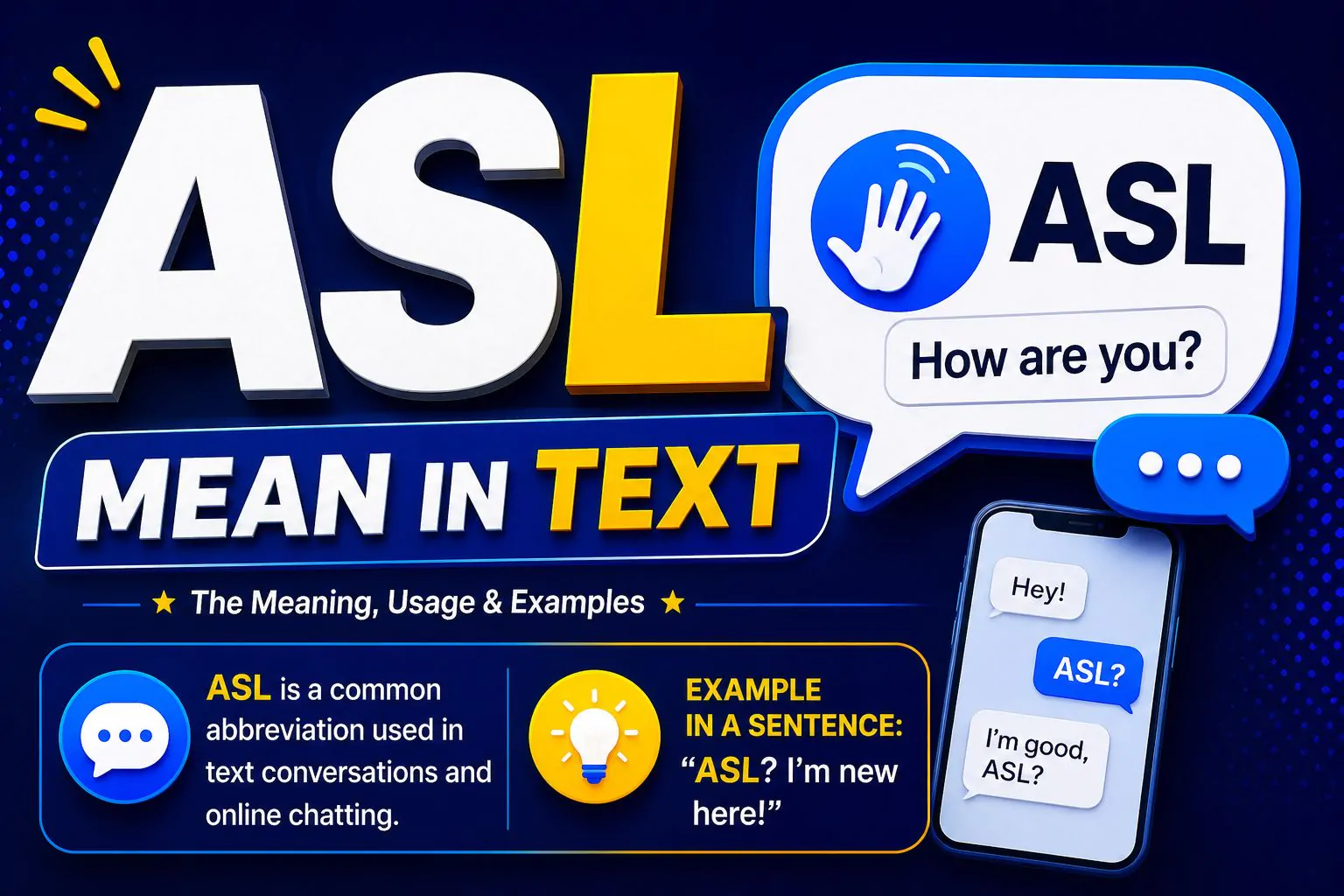
The most common ASL mean in text is “Age, Sex, Location.”
People use this abbreviation when they want to know someone’s basic information during an online conversation. Instead of typing three separate questions, they simply write “ASL?”
For example:
“Hi! ASL?”
The sender is asking:
“What is your age?”
“What is your gender?”
“Where are you from?”
A typical reply might be:
“22, Male, Texas.”
Or:
“19, Female, London.”
Although this abbreviation became popular decades ago, it is still recognized by many internet users today.
The History of ASL in Online Chat
The ASL mean in text became famous during the late 1990s and early 2000s when internet chat rooms were extremely popular.
Platforms such as AOL Instant Messenger, Yahoo Messenger, MSN Messenger, and IRC allowed strangers from around the world to chat instantly.
Since people wanted to introduce themselves quickly, they often started conversations by typing:
“ASL?”
This simple question immediately provided basic information about the other person.
Even though modern messaging apps have replaced many old chat rooms, ASL remains one of the most recognizable internet abbreviations.
Why ASL Became So Popular
The internet has always encouraged fast communication.
Instead of writing:
“How old are you?”
“Are you male or female?”
“Where do you live?”
People could simply type:
“ASL?”
The ASL mean in text saved time while allowing conversations to move quickly.
This efficiency helped ASL spread across online communities worldwide.
ASL Meaning on Snapchat
Snapchat conversations are usually informal and fast-paced.
Although ASL is less common than it was years ago, some users still send:
“ASL?”
On Snapchat, the abbreviation usually keeps its original meaning of Age, Sex, Location.
Someone may ask ASL after adding a new friend or joining a public conversation.
However, because sharing personal information online requires caution, users should avoid revealing private details to strangers.
ASL Meaning on Instagram
Instagram Direct Messages also feature internet slang.
When someone you’ve just met online sends:
“ASL?”
They’re typically asking about your age, gender, and location.
The ASL mean in text remains consistent across Instagram, especially when strangers begin chatting.
If you’re uncomfortable sharing personal information, it’s perfectly acceptable to decline politely.
ASL Meaning on TikTok
TikTok comments and direct messages occasionally include ASL.
For example:
“ASL? Love your videos.”
The creator may receive this question from followers who are curious about their background.
Although less frequent than other abbreviations, ASL still appears among users who recognize classic internet slang.
ASL Meaning in Gaming
Online multiplayer games bring together players from around the world.
Gamers often become friends through voice chat or text messaging.
Sometimes one player asks:
“ASL?”
They’re usually trying to learn basic information about another player before continuing the conversation.
The ASL mean in text remains the same in gaming communities, although many players now simply ask each question separately.
ASL Meaning in Dating Apps
Dating platforms are another place where ASL sometimes appears.
People often want to know basic information before deciding whether to continue chatting.
Instead of asking several questions individually, one person may simply write:
“ASL?”
Although convenient, many dating apps already display age and location in user profiles, making ASL less common than it once was.
Another Meaning of ASL
While Age, Sex, Location is the most common ASL mean in text, there is another important definition.
ASL also stands for American Sign Language.
This is a complete visual language used by members of the Deaf and hard-of-hearing community throughout the United States and parts of Canada.
For example:
“I’m learning ASL.”
Here, ASL clearly refers to American Sign Language rather than Age, Sex, Location.
Understanding the context makes it easy to determine which meaning is intended.
How Context Changes the ASL Meaning
Context is the key to interpreting internet abbreviations correctly.
Imagine someone sends:
“ASL?”
They’re likely asking for Age, Sex, and Location.
Now imagine another message:
“I’m taking ASL classes this semester.”
In this conversation, ASL obviously means American Sign Language.
Reading the surrounding messages helps you understand which definition fits naturally.
Is ASL Still Popular?
The ASL mean in text remains widely recognized, although it is less common than during the early internet era.
Many younger users prefer asking questions individually instead of using ASL.
However, people who used chat rooms in the late 1990s and early 2000s still recognize the abbreviation immediately.
It continues to appear occasionally on social media, messaging apps, gaming platforms, and online forums.
Should You Reply to ASL?
Whether you respond depends on who is asking.
If a trusted friend asks ASL during a casual conversation, you may feel comfortable answering.
However, if a complete stranger asks for your age, gender, and location, consider protecting your privacy.
Sharing personal information online should always be done carefully.
The ASL mean in text itself is harmless, but users should think carefully before revealing personal details to unknown individuals.
Other Meanings of ASL
Although the most recognized ASL mean in text is “Age, Sex, Location,” it is not the only definition you may encounter online. The abbreviation is also widely known as American Sign Language, a complete natural language used by the Deaf and hard-of-hearing community in the United States and parts of Canada.
In educational or accessibility-related conversations, ASL almost always refers to American Sign Language. For example, if someone says, “I’m studying ASL this semester,” they are talking about learning sign language rather than asking for personal information.
There are also a few industry-specific meanings of ASL in business, technology, and science. However, these definitions are uncommon in everyday texting. When people search for the ASL mean in text, they are usually referring to either Age, Sex, Location or American Sign Language.
Common Mistakes When Understanding ASL Mean in Text
Many people misunderstand ASL because they assume it has only one meaning. While the abbreviation has been part of internet culture for decades, its definition depends entirely on the conversation.
One common mistake is interpreting every instance of ASL as American Sign Language. If someone sends only “ASL?” in a chat, they are almost certainly asking for your age, gender, and location.
Another mistake is assuming everyone knows the abbreviation. Younger internet users may not be familiar with classic chat-room slang because modern social media platforms encourage different communication styles.
The easiest way to understand the ASL mean in text is to read the surrounding messages. Context almost always reveals the correct definition.
ASL Mean in Text vs Similar Internet Slang
The internet is full of abbreviations that make conversations shorter. Although ASL mean in text is one of the oldest internet acronyms, it differs from many modern texting abbreviations.
For example, WYA means “Where You At?” and asks about someone’s current location.
WYF means “Where You From?” and asks about a person’s hometown or country.
HYD means “How You Doing?” and is used to check on someone’s well-being.
TBH stands for “To Be Honest,” while IMO means “In My Opinion.”
Unlike these abbreviations, ASL asks three questions at once, making it unique among internet slang.
Is ASL Still Used Today?
Although ASL is not as common as it was during the early days of online chat rooms, many people still recognize and use it.
Older internet users who grew up with AOL Instant Messenger, MSN Messenger, Yahoo Messenger, and IRC often remember ASL as one of the first abbreviations they learned online.
Today, you may still encounter the ASL mean in text on Reddit, Discord, gaming communities, Facebook Messenger, Snapchat, Instagram, and occasionally on TikTok. However, many people now prefer asking individual questions rather than using the abbreviation.
Despite its reduced popularity, ASL remains one of the most recognizable pieces of internet slang.
When Should You Use ASL?
The ASL mean in text is best suited for casual conversations with people you know or in communities where internet slang is commonly understood.
If you’re chatting with friends, participating in online games, or joining casual discussion groups, ASL can be a quick way to ask basic introductory questions.
However, it is generally not appropriate for professional communication. In business emails, workplace chats, or conversations with clients, writing complete questions is much more professional.
It is also important to consider privacy. Asking strangers for personal information immediately after meeting them online may make some people uncomfortable.
Staying Safe When Someone Asks ASL
Whenever someone asks for your age, gender, and location online, think carefully before responding.
If the person is someone you know and trust, sharing basic information may be perfectly acceptable.
However, if the message comes from a complete stranger, you should avoid revealing sensitive personal details. Protecting your privacy online is always more important than satisfying someone’s curiosity.
Many social media platforms encourage users to keep personal information private, especially when interacting with unknown people.
The ASL mean in text itself is harmless, but your response should always depend on the situation.
Why Context Matters
Context is the best way to understand abbreviations like ASL.
Suppose someone writes:
“ASL?”
The person is probably asking for your age, gender, and location.
Now imagine another conversation:
“My university offers ASL classes.”
Here, ASL clearly means American Sign Language.
Similarly, a teacher might say:
“Learning ASL improves communication with the Deaf community.”
Again, the meaning is completely different.
Taking a moment to read the entire conversation helps prevent misunderstandings.
Related Texting Abbreviations You Should Know
Learning the ASL mean in text becomes even more useful when you’re familiar with other popular internet abbreviations.
LOL means “Laugh Out Loud.”
BRB means “Be Right Back.”
OMG means “Oh My God.”
IDK means “I Don’t Know.”
TBH means “To Be Honest.”
IMO means “In My Opinion.”
SMH means “Shaking My Head.”
WYA means “Where You At?”
WYF means “Where You From?”
FYM means “Fuck You Mean?” or, in some contexts, “For Your Mind,” depending on the conversation.
Understanding these abbreviations makes online conversations much easier to follow.
Conclusion
Understanding the ASL mean in text helps you communicate more confidently across today’s digital platforms. In most texting conversations, ASL stands for Age, Sex, Location and is used as a quick way to ask someone for basic introductory information. In educational or accessibility-related discussions, however, ASL almost always refers to American Sign Language.
The intended meaning depends entirely on context. Reading the surrounding conversation and considering the platform where the abbreviation appears will usually make the definition clear. If you’re ever unsure, asking for clarification is the best approach.
As online communication continues to evolve, classic internet slang like ASL remains an important part of digital culture. Knowing its meanings allows you to understand conversations more accurately and respond with confidence.
FAQs
The most common ASL mean in text is Age, Sex, Location. It is used to ask someone for basic personal information during an online conversation.
Yes. In educational and accessibility contexts, ASL stands for American Sign Language, a visual language used by the Deaf and hard-of-hearing community.
Yes. Although it is less common than it was in early internet chat rooms, ASL still appears on social media, messaging apps, gaming platforms, and online forums.
Only if you feel comfortable. If the person is a stranger, avoid sharing sensitive personal information and prioritize your online privacy.
ASL may appear in text messages, Snapchat, Instagram, Discord, Reddit, online games, and other casual messaging platforms. It can also refer to American Sign Language in schools, workplaces, and educational discussions.
More Slangs

Helping brands improve search visibility through expert guest posting, blogger outreach, quality backlink acquisition, and white-hat off-page SEO strategies that deliver results.