Ion Meaning in Text: The Complete Guide to This Viral Slang Term
You just received a text that says “ion know what to do lol” — and you froze. Is that a typo? A chemistry reference? A totally different language? Welcome to the fast-moving, endlessly inventive world of digital slang, where a single two-letter word can completely change what a sentence means.
If you’ve been trying to decode the ion meaning in text, you are far from alone. This compact expression has quietly taken over text conversations, Twitter threads, TikTok comments, and Snapchat chats across the English-speaking internet — particularly among Gen Z and younger millennials. Knowing what it means, where it came from, and how to use it correctly is the difference between keeping up with digital conversation and feeling completely out of the loop.
In this guide, we’ll break down everything you need to know about the ion meaning in text: its definition, origins, usage examples, tone, and context. Whether you’re a parent trying to decode your teenager’s messages, a professional navigating a new workplace culture, or simply someone who wants to stay fluent in the ever-evolving language of the internet, this is the only explainer you’ll need.
What Does “Ion” Mean in Text?
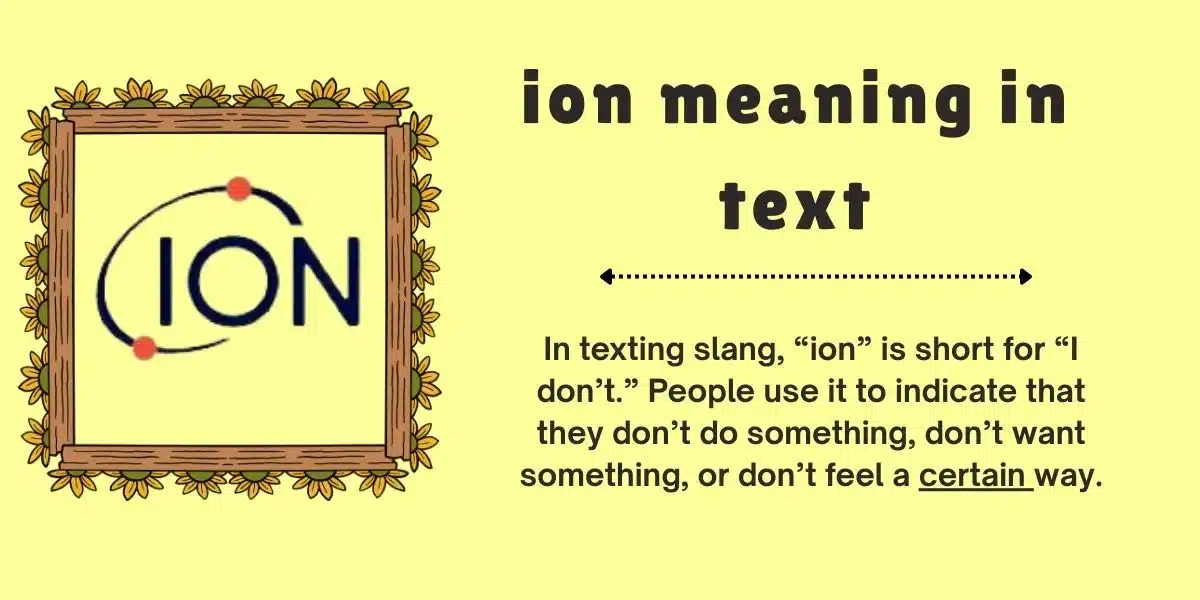
At its most fundamental level, the ion meaning in text is a shorthand for “I don’t.” When someone types “ion know,” they mean “I don’t know.” When someone writes “ion care,” they’re saying “I don’t care.” When you see “ion think so,” read it as “I don’t think so.”
The word is a phonetic compression — a way of collapsing “I” and “don’t” into a single, speedy syllable that slots effortlessly into the rhythm of casual digital communication. It captures the way many English speakers actually pronounce “I don’t” in fast, relaxed, everyday speech. In spoken language, we rarely separate every syllable cleanly. “I don’t” often comes out sounding much closer to “ion” in a quick, unguarded conversation, and at some point, texters simply started spelling it the way it sounded. The result is a slang term that feels immediate, effortless, and authentic.
Understanding the ion meaning in text immediately unlocks a whole set of common expressions:
- “ion know” — I don’t know (expressing uncertainty or indifference)
- “ion care” — I don’t care (showing nonchalance or mild dismissal)
- “ion think so” — I don’t think so (gentle disagreement)
- “ion wanna” — I don’t want to (expressing reluctance)
- “ion fw that” — I don’t f*** with that (strong dislike or avoidance)
- “ion even lie” — I don’t even lie (used as an emphasis of honesty — equivalent to “honestly” or “truthfully”)
As you can see, “ion” functions exactly the same way as “I don’t” in standard English. It precedes any verb or phrase, making it one of the most grammatically flexible pieces of slang in modern digital communication.
Where Did the “Ion” Slang Come From?
The origins of internet slang are often difficult to pinpoint with precision, but linguists and internet culture researchers generally trace the rise of phonetic text contractions — including the spread of the ion meaning in text — to African American Vernacular English, commonly known as AAVE.
AAVE is a dialect of American English with its own distinct phonological, grammatical, and lexical features, and it has historically had an outsized influence on American popular culture — from music, fashion, and comedy to the everyday vocabulary of casual conversation. Digital slang is no different. In spoken AAVE, contracting “I don’t” into a sound that closely resembles “ion” is a natural and longstanding phonological feature — not a mistake, not a sign of carelessness, but simply the way the language flows in informal registers.
When Black creators and internet users, particularly on platforms like Twitter, Vine, and later Instagram and TikTok, began writing in a way that reflected their natural speaking patterns, expressions like “ion” found a wider online audience remarkably quickly. The ion meaning in text follows this well-documented trajectory of AAVE vocabulary entering mainstream internet culture, often without widespread acknowledgment of its origins.
By the mid-2010s, “ion” had become a fixture of Twitter and Tumblr. By the early 2020s, it had been absorbed into the mainstream slang dictionary of English-speaking social media users across every major platform. Today you’ll encounter it in text messages, Instagram captions, YouTube comments, Discord servers, Reddit threads, and beyond.
How Slang Travels From Speech to Screen
The journey from spoken dialect to widely adopted written slang is a fascinating window into how language evolves in the digital age. Historically, written language tended to be more formal than spoken language — writing lagged behind speech and maintained certain standards of grammar and vocabulary that informal talk happily ignored. But digital communication, especially texting, Twitter, and messaging apps, has radically reversed that dynamic.
Today, people write the way they talk — or, more precisely, they write the way they want to sound. Platforms that reward authenticity, speed, and relatability have created enormous pressure for language to be immediate and unpolished. In that environment, terms like “ion” — rooted in how people actually speak — thrive and spread at a pace that would have been unimaginable in any earlier era.
How “Ion” Is Used in Different Contexts
Knowing the ion meaning in text is the first step. Using it fluently requires understanding the different emotional tones and social situations it fits — because like all slang, “ion” carries different weight depending on context, relationship, and surrounding conversation.
Expressing Uncertainty
One of the most common uses of “ion” is to convey uncertainty in a casual, unbothered way. “Ion know what’s happening lol” is far more relaxed and relatable than “I don’t know what’s happening.” The abbreviated form signals ease and informality, as though the speaker is too chill to bother with a full construction. It’s the textual equivalent of a shrug.
When someone uses “ion know” instead of “idk” or “I don’t know,” there’s often a slightly more emphatic, speech-like quality to it — it sounds more like natural talking than typing. That’s precisely why it resonates with people who want their texts to feel genuine rather than composed.
Showing Indifference or Nonchalance
When someone wants to communicate that they genuinely don’t have strong feelings about something, “ion care tbh” (tbh = to be honest) hits differently than simply writing out the full phrase. The compression reinforces the nonchalance itself — as if the speaker couldn’t be bothered to type all five letters of “don’t.” The ion meaning in text in this use carries a tone of effortless, almost theatrical detachment that the longer version struggles to replicate.
This is a subtle but real feature of how slang works: the form of the expression communicates as much as the content. Choosing a compressed, casual form signals something about your attitude before the meaning even lands.
Soft Refusals and Reluctance
“Ion really wanna go ngl” (ngl = not gonna lie) is a gentle, low-friction way to decline something or express hesitation. It avoids sounding harsh or confrontational while still making the speaker’s feelings clear. In text communication, where tone is notoriously easy to misread, these softer, more conversational constructions are genuinely useful tools. They let someone say no — or express reluctance — without the risk of coming across as cold or dismissive.
Honesty and Emphasis
One of the most interesting and slightly counter-intuitive uses of “ion” is in the phrase “ion even lie.” Here, the slang flips its usual function entirely — instead of declining or negating something, it’s being deployed as an emphatic declaration of sincerity. “Ion even lie, that was the best meal I’ve ever had” means “I’m genuinely telling you — no exaggeration — that was the best meal I’ve ever had.”
This usage beautifully demonstrates how flexible and creatively alive slang can be. Words don’t just carry fixed meanings; they bend and stretch to fill communicative needs, and “ion” has proven remarkably versatile in doing exactly that.
“Ion” vs. Other Slang: Knowing the Difference
Internet slang can become confusing quickly, especially when multiple terms overlap in meaning. Understanding the ion meaning in text is clearer when you can see how it sits alongside related abbreviations.
“Idc” — standing for “I don’t care” — technically conveys the same meaning as “ion care,” but the two carry noticeably different tones. “Idc” can read as blunt, dismissive, or even passive-aggressive, while “ion care” tends to feel more casual and conversational. Similarly, “idk” (I don’t know) is a slightly older, more universally recognized abbreviation, while “ion know” carries a more distinctly Gen Z, social-media-native flavor.
The key difference is register and texture. “Idk” and “idc” belong to a slightly earlier era of internet shorthand — clean, efficient, but somewhat stripped of personality. “Ion,” with its phonetic roots in natural speech, feels warmer, more informal, and more embedded in current online culture. Choosing between them is less about meaning and more about the vibe you’re aiming for.
Why “Ion” Has Become So Widely Used
The spread of the ion meaning in text across platforms is not accidental. A combination of linguistic, cultural, and technological forces has made it particularly sticky and durable as a piece of modern slang.
Efficiency in Digital Communication
Texting culture consistently rewards brevity. The fewer keystrokes required to express a thought, the better — especially when conversations move quickly. “Ion” compresses a three-word phrase into a single token. That kind of efficiency genuinely matters in a world where messaging is rapid-fire and attention is scarce. Slang like “ion” isn’t lazy: it’s optimized for the medium it lives in.
Authenticity and Belonging
Part of what makes the ion meaning in text so resonant is that it mirrors actual speech patterns. When you type “ion,” you’re writing the way people naturally talk — or the way you’ve heard people around you talk. That authenticity creates a sense of intimacy and community. Using slang correctly signals that you’re part of a shared cultural space, that you understand its codes, rhythms, and norms. It’s a small but meaningful marker of belonging.
Gen Z’s Influence on Digital Language
Gen Z — the first generation to grow up entirely in the smartphone era — has developed a distinctive digital communication style that prizes authenticity, irony, brevity, and emotional rawness. Slang terms like “ion” fit perfectly into that aesthetic. They’re unpolished, phonetic, and feel real in a way that carefully composed sentences never quite do. As Gen Z content creators have come to dominate TikTok, Instagram Reels, and Twitter, their linguistic habits have filtered into the mainstream at extraordinary speed, normalizing expressions that might once have seemed niche or regional.
Is “Ion” Appropriate to Use in All Conversations?
Once you’ve understood the ion meaning in text, the practical question becomes: when should you actually use it? Like all slang, “ion” has a register — it belongs naturally in certain contexts and would be jarringly out of place in others.
In casual texts with friends, in social media posts, in Discord servers, in group chats, and in informal online communities, “ion” is entirely at home. It flows naturally, reads as authentic, and signals that you’re comfortable in a conversational, informal register.
In professional emails, formal writing, academic work, job applications, or any communication where you need to project competence and seriousness, “ion” would be significantly out of place. Context is everything. The language that sounds natural and relatable in a WhatsApp thread with close friends would actively undermine your credibility in a workplace setting.
A reliable rule of thumb: use slang wherever you’d comfortably speak informally out loud. If you’d use casual speech with that person or in that setting, slang is probably appropriate. If not, default to standard formal language.
Other Meanings of “Ion” — Potential Confusion
It’s worth acknowledging that “ion” has other meanings outside the world of texting slang, which can occasionally cause confusion — particularly for older readers, non-native English speakers, or anyone encountering the slang version for the first time.
In chemistry and physics, an ion is an atom or molecule that carries a net electric charge because it has gained or lost one or more electrons. Cations carry a positive charge; anions carry a negative charge. This scientific meaning of “ion” has nothing to do with the slang usage and has been in use for well over a century.
In broadcasting, ION is also the name of an American television network that operates independently of the major broadcast groups.
In nearly every real text conversation, context will make the meaning unmistakable. The slang sense of the ion meaning in text is instantly recognizable because it always precedes a verb or verb phrase, just as “I don’t” would in standard English. No one writes “the ion drifted toward the cathode” in a casual text — so the moment you see “ion” followed by a verb like “know,” “care,” or “wanna,” you can be certain you’re looking at the slang form.
Tips for Using “Ion” Naturally in Your Own Messages
If you want to start using “ion” in your conversations, a few practical pointers will help you do so in a way that feels natural rather than forced.
The most universally understood entry point is “ion know.” This phrase is widely used, instantly understood across age groups that spend time online, and easy to drop into a casual exchange. Starting there — “ion know, what do you think?” — is a low-risk way to get comfortable with the term.
Pay attention to how people around you, particularly younger contacts, actually use it. Slang is best absorbed organically, through reading and listening, rather than through deliberate insertion. The more you see the ion meaning in text used naturally in real conversations, the more intuitive your own use will become.
Avoid overusing it. Slang works best when it punctuates conversation rather than dominating it. A well-placed “ion know” reads as authentic and natural. Using it every other sentence starts to look performative, which is the exact opposite of the effortless, casual quality that makes slang compelling in the first place.
Conclusion: The Ion Meaning in Text, Fully Decoded
Language is always moving — shifting, compressing, expanding, and borrowing from every direction. The ion meaning in text is a small but vivid illustration of how digital communication has become one of the most dynamic arenas for linguistic change in human history. From its roots in the natural phonological patterns of spoken AAVE to its rapid spread across every major social platform, “ion” tells us something genuinely interesting: that language serves the people who use it, and people who communicate quickly, informally, and authentically will always find elegant shortcuts.
Whether you’ve been confused by this term, amused by it, or have simply been looking to stay fluent in the vocabulary of modern digital life, you now have everything you need. The ion meaning in text is “I don’t” — simple, versatile, expressive, and perfectly calibrated for the casual conversations that define how we connect online today.
Next time someone texts you “ion know lol,” you’ll know exactly what they mean. And if the moment calls for it — you might even text it back.
Frequently Asked Questions
What does “ion” mean in a text message?
“Ion” in a text message means “I don’t.” It is a phonetic shorthand that mirrors the way “I don’t” sounds in casual, rapid speech. For example, “ion know” means “I don’t know,” and “ion care” means “I don’t care.” It is widely used in informal digital communication, especially among Gen Z and younger millennials.
Is “ion” slang only used by Gen Z?
While “ion” originated primarily in Gen Z and younger millennial online communities, it has spread broadly across social media and messaging platforms and is now used by a wide range of people who participate in casual internet culture. It remains most common among younger demographics, but it is no longer exclusive to any single age group.
Where did the slang “ion” come from?
The slang “ion” is rooted in African American Vernacular English (AAVE), where contracting “I don’t” into a phonetic sound resembling “ion” is a natural speech feature. When Black creators and online users shared content written in their natural speaking style on platforms like Twitter and Vine, the term was adopted widely across internet culture during the mid-to-late 2010s.
Can “ion” be confused with other meanings of the word?
Yes — in chemistry, an “ion” is a charged atom or molecule, and ION is also the name of an American television network. In text conversations, however, the slang meaning is almost always immediately clear from context, since it appears before a verb phrase just as “I don’t” would in standard English.
Is it appropriate to use “ion” in professional or formal writing?
No. “Ion” is strictly an informal, casual slang term appropriate only in relaxed personal conversations — texts with friends, social media posts, online chats, and similar informal spaces. Using it in professional emails, academic writing, job applications, or formal documents would be inappropriate and could undermine how seriously you are perceived.

Helping brands improve search visibility through expert guest posting, blogger outreach, quality backlink acquisition, and white-hat off-page SEO strategies that deliver results.