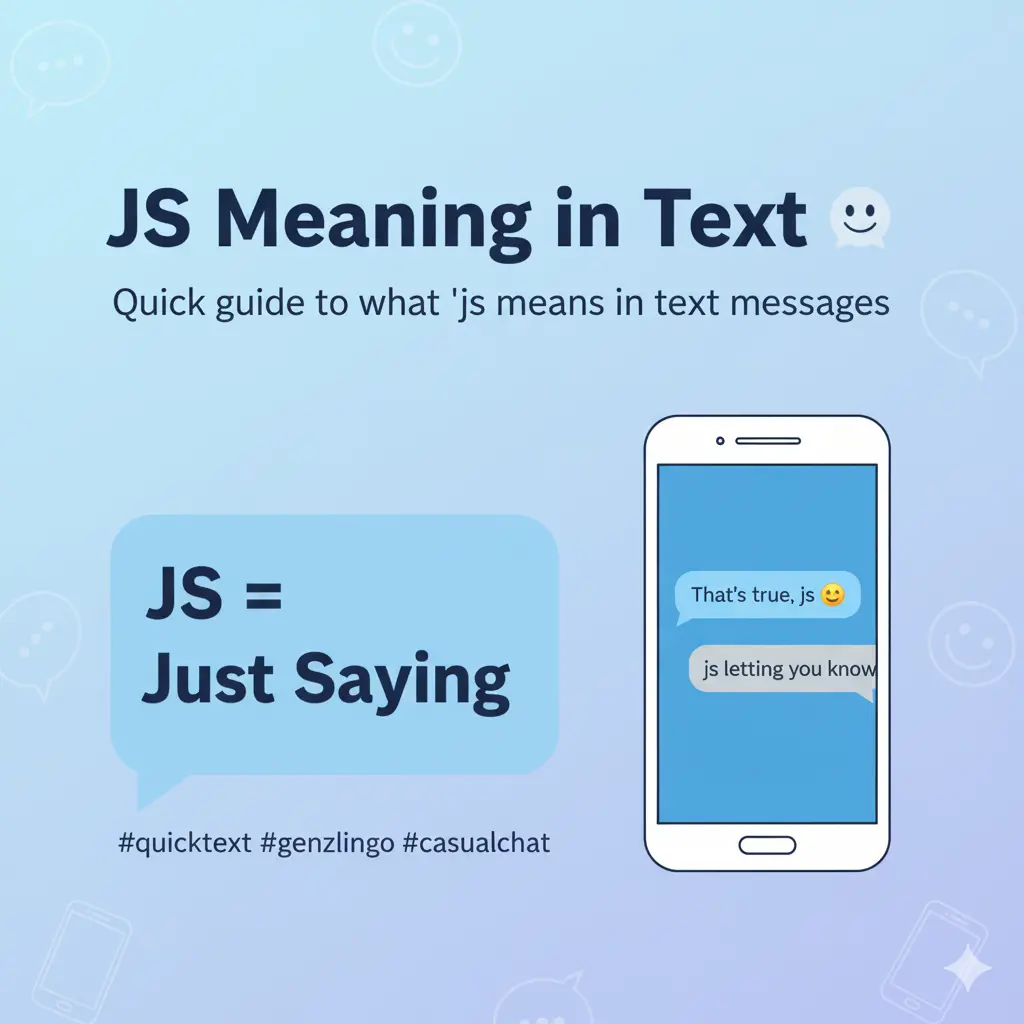
What Does JS Mean in Text? The Complete Guide to Understanding “JS” in Digital Conversations
If you’ve ever received a message with the abbreviation “JS” and found yourself staring at your screen wondering what the sender actually meant, you’re not alone. In today’s fast-paced world of texting, social media, and instant messaging, abbreviations fly around constantly — and js mean in text conversations can carry more than one meaning depending on the context. This guide breaks down everything you need to know about this popular shorthand, where it comes from, how it’s used, and why getting it right actually matters.
What Does JS Mean in Text? The Simple Answer
At its most basic level, JS in text stands for “Just Saying.” It’s a conversational phrase people use at the end of a statement to soften an opinion, add a light disclaimer, or simply signal that they’re being candid without wanting to come across as confrontational.
Think of it as a verbal shrug. You make a statement, add “js” at the end, and suddenly the message feels a little more casual, a little more honest, and a lot less aggressive. It’s the digital equivalent of saying something and then adding, “No offense, though.”
For example:
“That movie was actually kind of boring, js.”
Or:
“You really should text back faster, js.”
In both cases, the speaker is expressing a real opinion but wrapping it in a soft landing so it doesn’t feel like a direct attack. That’s the social magic behind js mean in text usage — it lets people be honest without fully committing to a confrontation.
The Origins of “JS” as a Text Abbreviation
Like most internet slang, js didn’t emerge from a formal dictionary or official communications guide. It grew organically out of online chat culture, SMS texting, and platforms like Twitter, Snapchat, and Instagram where character limits and speed made abbreviations essential.
“Just Saying” as a full phrase has been part of casual English speech for decades. You’d hear it in everyday conversation: “I mean, I’m just saying…” — as a way to introduce an awkward truth or soften a pointed remark. When texting took off in the early 2000s and social media exploded in the 2010s, the phrase naturally got compressed into js.
Today, it’s a staple of informal digital communication, particularly among younger demographics like Gen Z and Millennials who’ve grown up with shorthand as a primary mode of expression. Understanding js mean in text scenarios has become almost a cultural literacy requirement for anyone participating in modern digital conversations.
Other Meanings of JS in Different Contexts
Here’s where things get a bit more nuanced. While “Just Saying” is the dominant meaning when you see js in text messages, the abbreviation doesn’t always mean the same thing. Context is king, and depending on who is talking to whom — and on what platform — js can refer to something entirely different.
JS as JavaScript
In tech circles, developer forums, coding communities, and platforms like GitHub or Stack Overflow, JS almost universally refers to JavaScript — one of the world’s most widely used programming languages. If a developer says, “I built the entire front end in JS,” they’re talking code, not casual conversation.
Understanding this distinction is crucial. The same two letters carry completely different weight depending on the setting. A teenager texting a friend and a software engineer discussing a codebase are both using “JS,” but the meaning couldn’t be more different.
JS as an Initialism for a Name
Sometimes, js or JS in a text thread might simply be someone’s initials. If you’re talking about a colleague, friend, or public figure whose first and last name both start with those letters, JS becomes a reference to a person rather than a phrase or language.
Always consider the conversation’s subject matter when decoding js mean in text exchanges to make sure you’re reading the right meaning.
JS in Academic or Formal Notes
In some note-taking or academic shorthand systems, JS can appear as a code or abbreviation for subjects, journal names (like Journal of Sociology or Journal of Science), or even a category marker. This usage is rare in everyday texting but worth noting for completeness.
How “Just Saying” Works Socially: The Tone Behind the Text
Language in text form loses a lot of the nuance that comes with tone of voice, facial expression, and body language. That’s one reason abbreviations like js have become so socially useful — they act as tone markers.
When someone drops js at the end of a message, they’re communicating several things at once. They’re saying: “This is my honest opinion. I mean it. But I’m not trying to start a fight.” It’s a rhetorical tool that softens the edge of criticism or candid feedback.
Consider the difference between these two texts:
“Your presentation wasn’t that impressive.”
versus
“Your presentation wasn’t that impressive, js.”
The second one reads as less hostile. The speaker still gets their point across, but the addition of js signals that they’re not trying to wound the recipient — they’re just being real. This is exactly why understanding js mean in text usage is valuable for anyone navigating digital communication today.
When and How to Use JS in Your Own Messages
Knowing what js means is one thing. Using it effectively is another. Here’s a practical look at when this abbreviation fits naturally and when it might backfire.
Situations Where JS Works Well
In casual, friendly conversations between people who already have a comfortable rapport, js lands naturally. It’s ideal for:
Expressing an opinion you want to share without starting an argument. Dropping a mild piece of advice in a non-preachy way. Acknowledging a situation honestly without making someone feel judged. Adding humor or irony to a statement where tone might otherwise be unclear.
“I think we should’ve ordered the other pizza, js.”
“You’ve been talking about that show for three weeks and I still haven’t seen it, js.”
In these examples, the tone is light, conversational, and low-pressure.
When JS Can Miss the Mark
Like any abbreviation, js can misfire in the wrong context. Using it in formal or professional communication is a clear misstep. Sending your manager a performance note with “js” attached to a criticism will likely come across as flippant or disrespectful.
Similarly, in a serious emotional conversation, adding js to a sensitive comment can make it seem like you’re trivializing the situation. Empathy rarely benefits from a casual hashtag or a shorthand qualifier.
Knowing js mean in text environments well means knowing when to use it and when to reach for a more considered approach.
JS vs. Similar Text Abbreviations: What’s the Difference?
The world of texting slang is crowded, and several abbreviations carry similar vibes to js. It’s worth understanding how they differ so you can choose the right one — or at least understand what others are saying.
JK vs. JS
JK means “Just Kidding” and is used to walk back a statement, signal that something was a joke, or add playful irony. JS, by contrast, doubles down on sincerity. If JK softens by retreating, JS softens by acknowledging the honesty upfront.
“You look tired today, jk!” — pretending the comment was a joke. “You look tired today, js.” — owning the observation with a light touch.
NGL vs. JS
NGL stands for “Not Gonna Lie” and functions very similarly to js — both signal honesty or candid opinion. The subtle difference is that NGL usually comes before the statement, while js is more often added after.
“NGL, that was a bad decision.” “That was a bad decision, js.”
Both mean essentially the same thing, but the positioning changes the rhythm of the sentence.
TBH vs. JS
TBH — “To Be Honest” — is another close cousin. All three (ngl, tbh, js) function as honesty markers in casual digital communication. They signal vulnerability and authenticity in a world where people are often guarded in how they communicate.
Understanding these distinctions helps you fully decode the landscape of js mean in text conversations and navigate digital dialogue like a pro.
Why Text Abbreviations Like JS Keep Evolving
Language is never static. It grows, contracts, and reshapes itself based on culture, technology, and social trends. The rise of abbreviations like js is a direct result of how we communicate in the digital age — faster, shorter, more visual, and often across multiple platforms at once.
Social media platforms reward brevity. Twitter’s character limits, Instagram captions, and Snapchat’s ephemeral format all push users to compress language. As a result, a rich vocabulary of shorthand has developed that does a remarkable job of conveying tone, nuance, and intent in just two or three letters.
What makes js mean in text culture so fascinating is how much social and emotional intelligence it packs into a tiny abbreviation. The fact that two letters can soften a criticism, acknowledge an awkward truth, or add a wry edge to an observation says a lot about how sophisticated informal digital language has become.
Platforms Where You’re Most Likely to See JS
Different platforms have different communication cultures, and the frequency with which you encounter js varies accordingly.
On Snapchat and Instagram DMs, js is extremely common. These platforms are dominated by younger, casual communicators who use abbreviations fluently and naturally.
On Twitter/X, js appears regularly in quote tweets or replies where someone is adding a candid take: “This take aged poorly, js.”
On TikTok comments, js often adds a layer of dry humor or gentle shade to observations about the video content.
On iMessage and WhatsApp, js pops up in casual group chats or one-on-one conversations among friends.
You’re far less likely to see it in email, LinkedIn messages, or any formal written communication — and that distinction tells you a lot about the appropriate register for js mean in text contexts.
The Cultural Significance of Casual Language Online
There’s a broader story here beyond just one abbreviation. The explosion of text slang — including js, ngl, tbh, imo, and dozens of others — reflects a genuine shift in how people relate to language. Formal, rigid communication has given way to a more fluid, expressive, and democratized form of expression.
This isn’t a decline in literacy, as some critics suggest. It’s an expansion of it. People who use js fluently in text conversations are demonstrating a sophisticated understanding of tone, audience, and context. They know when to be formal and when to be casual. They’re code-switching — moving between registers depending on the situation — which is a sign of high communicative intelligence.
Understanding js mean in text conversations is therefore not just about decoding slang. It’s about participating fully and authentically in how communication actually works today.
Conclusion: JS Is Small but Mighty
Two letters. That’s all js is. But as we’ve seen throughout this guide, those two letters carry real communicative weight. Whether it’s softening an opinion, adding a candid edge, or simply signaling honesty in a fast-moving conversation, js mean in text usage reflects the creativity and efficiency of modern digital language.
If you’re new to this abbreviation, now you know exactly what to do when you see it — and how to use it yourself with the right tone and in the right moment. And if you’ve been using it for years, hopefully this deep dive has given you a new appreciation for how much social intelligence lives inside everyday text slang.
Language belongs to the people who use it, and right now, those people are expressing themselves one abbreviation at a time.
Frequently Asked Questions About JS in Text
In most text message conversations, JS stands for “Just Saying.” It’s used to soften an opinion, add a candid remark, or signal honesty without being aggressive. It typically appears at the end of a sentence as a casual qualifier.
Yes. In technology and programming contexts, JS stands for JavaScript, one of the most popular coding languages in the world. It can also be someone’s initials or an abbreviation used in academic journal names. The meaning depends entirely on the context of the conversation.
Generally, no. JS and similar text abbreviations belong in casual, informal conversations. Using them in professional emails, work reports, or formal messages can come across as unprofessional or flippant. Stick to full phrases in workplace communication.
JK means “Just Kidding” and is used to signal that a statement was a joke or to take back a comment. JS means “Just Saying” and doubles down on the sincerity of a statement rather than retreating from it. One walks back; the other leans in.
JS grew out of the broader culture of online chat and text messaging that exploded in the early 2000s and accelerated through social media in the 2010s. The full phrase “just saying” has long been part of casual English speech, and like many common phrases, it was naturally compressed into a quick abbreviation as digital communication demanded faster, shorter expression.

Helping brands improve search visibility through expert guest posting, blogger outreach, quality backlink acquisition, and white-hat off-page SEO strategies that deliver results.