What Does ML Mean in Text? The Complete Guide to This Popular Abbreviation
If you have ever received a text or seen a comment online with the abbreviation “ML” and paused for a moment, you are not alone. Understanding what ML mean in text is one of those small digital literacy questions that a surprising number of people type into search engines every single day. And it makes complete sense — modern communication is packed with shorthand, acronyms, and slang that evolve faster than any dictionary can keep up with.
This guide is going to break down everything you need to know about the abbreviation ML across texting, social media, online gaming, and even professional messaging contexts. By the time you finish reading, you will never second-guess this particular abbreviation again.
The Most Common Answer: What ML Mean in Text Conversations
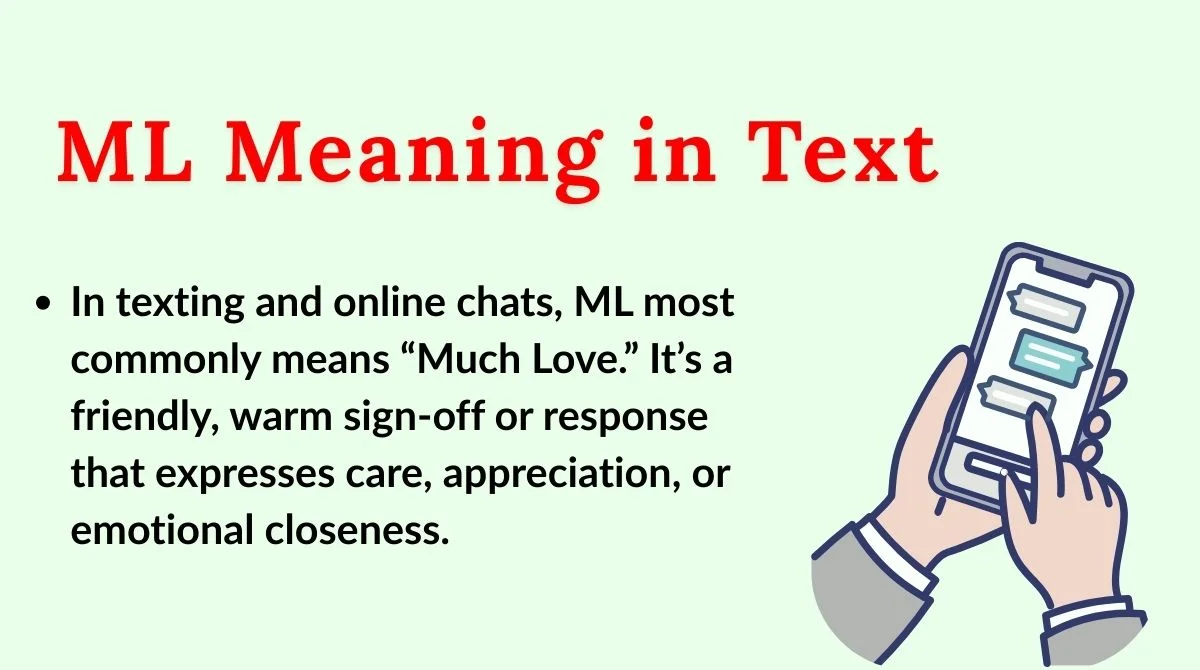
When someone uses ML in a casual text message or a social media comment, the most widely recognized meaning is “Much Love.” This interpretation is especially popular among friends, family members, and close social circles who want to sign off a message warmly without typing the full phrase.
Think of it as a digital equivalent of a hug at the end of a conversation. You might see it at the end of a supportive message, a thank-you note, or simply as a way of saying goodbye. For example, “Thanks for being there for me last night, ML” carries genuine warmth in very few characters. That is the beauty of texting shorthand — emotion compressed into two letters.
The “Much Love” interpretation of ML is so deeply embedded in everyday texting culture that most people between the ages of 15 and 35 would immediately recognize it in this context. It functions similarly to other affectionate closings like “xoxo” or “luv ya,” but with a slightly more understated and gender-neutral tone.
ML Also Means “My Love” — A Subtle But Important Difference
Here is where things get a little nuanced. While “Much Love” is the dominant interpretation, understanding what ML mean in text also involves recognizing its use as “My Love.” The difference matters depending on who is sending the message.
“Much Love” tends to be used broadly — between friends, between a parent and child, or even between acquaintances who share a warm connection. “My Love,” on the other hand, carries a more intimate, romantic charge. If someone sends you a good morning message ending with “ML,” context will tell you whether they mean “Much Love” as a friendly send-off or “My Love” as a term of endearment.
This dual interpretation is one reason why knowing the relationship dynamics and conversational context around ML mean in text discussions is just as important as knowing the literal definition. Two letters, two possible messages — and the difference between them can feel significant depending on who is in the conversation.
ML in Social Media Comments and Group Chats
Social media has added even more layers to how people use abbreviations. On platforms like Instagram, TikTok, Twitter (now X), and Snapchat, you will often see ML dropped into comments as a gesture of solidarity or affection. A friend commenting “ML babe, you killed it” under a photo is using it as enthusiastic support, almost as a mini celebration.
In group chats, ML serves a slightly different purpose. It often acts as a warm but casual sign-off when someone is leaving the conversation, or as a quick emotional acknowledgment in response to something someone shared. Group chats thrive on abbreviated emotional cues — reactions, emojis, and shorthand — and understanding what ML mean in text group settings helps you read the emotional temperature of those spaces more accurately.
It is also worth noting that younger generations have started blending ML with emojis, creating combinations like “ML” or “ML bestie” that feel more expressive and personalized. The abbreviation itself has become a building block rather than a standalone statement.
Beyond Texting: Other Meanings of ML You Should Know
While the conversational meanings dominate casual messaging, ML carries entirely different definitions in other contexts. Being aware of these alternate meanings ensures you correctly interpret what ML mean in text depending on the setting.
ML as Machine Learning
In professional, academic, and tech industry communications, ML almost universally refers to Machine Learning — a branch of artificial intelligence focused on building systems that learn and improve from data without being explicitly programmed. If you are in a Slack channel at a tech company and someone says “we need to integrate ML into the pipeline,” they are not expressing affection. They are talking about algorithms.
Machine Learning has become one of the most discussed topics in modern technology, spanning industries from healthcare to finance to entertainment. When you see ML in a LinkedIn post, a tech blog comment, or a professional email thread, this is almost certainly the intended meaning.
ML as Milliliters
In everyday practical contexts — particularly cooking, medicine, fitness, and science — ML stands for milliliters, a standard unit of liquid measurement in the metric system. A nurse noting “give 5 ML of solution” or a recipe saying “add 250 ML of water” is using a globally recognized measurement abbreviation. This is likely the oldest and most technically standardized meaning of the abbreviation.
ML in Gaming Communities
Online gaming communities have their own rich slang ecosystem, and ML here often refers to Mobile Legends, one of the most popular multiplayer online battle arena (MOBA) games in Southeast Asia and beyond. Gamers discussing strategies, team compositions, or match results will casually throw around “ML” without any romantic connotation whatsoever. If someone in a Discord server says “anyone up for ML tonight?” they are almost certainly asking about a gaming session.
How Context Shapes What ML Mean in Text
One of the most important communication skills in the digital age is reading context, and this applies strongly to how you interpret what ML mean in text messages. The same two letters carry completely different weight depending on several key factors.
Who is sending the message? A close friend sending “take care, ML” means something different than a romantic partner using the same sign-off. Your relationship with the sender is the first filter through which you should process the abbreviation.
What platform are you on? A message on a gaming Discord server, a professional Slack workspace, and a personal WhatsApp chat are three entirely different communication environments. Each one tilts the probability toward a different definition of ML.
What is the surrounding conversation about? If you have been chatting about your emotional struggles and someone responds with “I hear you, ML,” the context makes the meaning clear. If you are in the middle of a conversation about software development and someone says “we need more ML expertise,” the meaning is equally obvious.
Developing this kind of contextual reading skill makes you not just a better text interpreter but a more empathetic digital communicator overall.
Why Abbreviations Like ML Have Become So Dominant in Digital Communication
The rise of abbreviations is not random — it reflects deep shifts in how humans communicate. Texting and instant messaging are built for speed. The physical and cognitive effort of typing long messages on a smartphone has pushed language toward compression. Abbreviations like ML allow people to convey emotional nuance quickly without losing warmth.
There is also a social bonding dimension. Using shared shorthand signals in-group membership. When two people both know what ML mean in text without having to explain it, that shared fluency creates a small but meaningful moment of connection. Slang and abbreviations function partly as social glue, binding communities together through shared linguistic code.
According to linguists who study digital communication, this kind of language compression is not a degradation of communication but an evolution of it. People are not losing the ability to express themselves; they are finding more efficient ways to do so in new mediums.
The Evolution of ML and Similar Abbreviations Over Time
Language is always moving. The meaning of ML in text messages has expanded and shifted over the past two decades. In the early days of SMS texting, character limits were genuinely restrictive, and abbreviations were practical necessities. As smartphones removed those limits, abbreviations evolved from tools of necessity to tools of style and identity.
Today, what ML mean in text can shift depending on the generation using it, the platform hosting the conversation, and the cultural moment in which it is used. Younger users on TikTok may use ML in ways that differ subtly from how millennials use it on Facebook Messenger. That drift is a sign of a living, breathing linguistic ecosystem rather than a fixed code.
If you want to stay current, the best approach is to follow the conversational norms of the specific communities and platforms you participate in. Slang dictionaries like Urban Dictionary and academic resources like Netlingo track these shifts in real time and can serve as helpful references when you encounter unfamiliar uses.
A Quick Note on Similar Abbreviations That Get Confused With ML
It helps to distinguish ML from other abbreviations it sometimes gets mixed up with. “LML” often means “Love My Life” or occasionally “Laughing Mad Loud.” “MLM” stands for “Multi-Level Marketing” in business contexts, though in some casual circles it has started appearing as “Much Love and Memories.” “MLS” typically refers to Major League Soccer or Multiple Listing Service in real estate.
Keeping these distinctions clear helps you avoid misreading messages and ensures you are sending the right signal when you use ML yourself. The more precisely you understand these abbreviations, the more confident and natural your digital communication becomes.
Should You Use ML in Your Own Texts?
Knowing what ML mean in text naturally leads to the question of whether you should start using it yourself. The honest answer is: use it when it feels natural and appropriate for your relationship and platform.
If you already use warm, affectionate language in your texts, ML can be a genuinely expressive and efficient way to sign off or add a touch of warmth. It reads as genuine when it matches your overall communication style. Forcing it into messages where it feels out of place, however, can come across as trying too hard or as confusing.
Start by noticing how the people in your own social circles use it. Language is social, and abbreviations land best when they are shared fluently rather than imported awkwardly.
Conclusion: Understanding What ML Mean in Text Makes You a Better Digital Communicator
Knowing what ML mean in text is one small but genuinely useful piece of modern communication literacy. Whether it signals “Much Love” from a close friend, “My Love” from a romantic partner, “Machine Learning” from a tech colleague, or “Mobile Legends” from a gamer friend, the meaning is always rooted in context.
Language in the digital age rewards attentiveness. The more carefully you read the people, platforms, and conversations around any abbreviation, the more accurately and meaningfully you can interpret and respond. ML is just two letters — but those two letters carry a surprisingly rich range of human meaning, connection, and intent.
So the next time you see ML at the end of a message, you will not just know the definition. You will understand the feeling behind it.
Frequently Asked Questions About ML Mean in Text
Q1: What does ML mean in a text message from a friend?
In most casual text conversations between friends, ML stands for “Much Love.” It is a warm, affectionate sign-off that expresses care and closeness without sounding overly formal or romantic. You might see it at the end of a supportive conversation, a funny exchange, or simply as a friendly goodbye.
Q2: Can ML mean something romantic in texting? Y
es, ML can also stand for “My Love” in romantic contexts. Whether it reads as romantic or simply friendly depends entirely on the relationship between the people texting and the emotional tone of the conversation. In an intimate relationship, ML is often used as a tender term of endearment.
Q3: What does ML mean in professional or tech-related messages?
In professional settings, especially in technology, engineering, data science, and business communications, ML almost always refers to Machine Learning — a field of artificial intelligence that enables systems to learn from data. If you encounter ML in a workplace Slack, LinkedIn post, or tech article, this is the intended meaning.
Q4: Does ML have a meaning in gaming?
Yes. In gaming communities, particularly in Southeast Asia and among mobile gamers worldwide, ML is a common shorthand for Mobile Legends, a hugely popular MOBA game. Gamers use it casually when discussing matches, strategies, or inviting others to play.
Q5: How do I know which meaning of ML someone is using?
The best way to determine what ML mean in text is to assess the context: consider your relationship with the sender, the platform you are communicating on, and the subject matter of the conversation. A tech professional using ML in a work chat almost certainly means Machine Learning, while a friend ending a heartfelt message with ML almost certainly means Much Love. Context is always your most reliable guide.
This article was written to provide accurate, helpful, and original information about digital communication and text abbreviations. For further reading on internet slang and evolving language, you may find resources like Merriam-Webster’s Words at Play and Netlingo useful.

Helping brands improve search visibility through expert guest posting, blogger outreach, quality backlink acquisition, and white-hat off-page SEO strategies that deliver results.