HMU Meaning: What Does HMU Mean in Text, Chat & Social Media?
You got a text from a friend saying “HMU later!” — and now you’re staring at your phone, wondering what exactly they mean. You are definitely not alone. The HMU meaning is one of the most searched internet slang questions today, and for good reason: this little three-letter abbreviation pops up everywhere, from Instagram Stories to Snapchat captions to everyday text conversations.
Whether you’re a seasoned texter trying to brush up on modern slang, a parent trying to decode your teenager’s messages, or simply someone new to the digital communication scene, this guide breaks down everything you need to know about HMU — what it stands for, how to use it correctly, where it came from, and when you should probably avoid it.
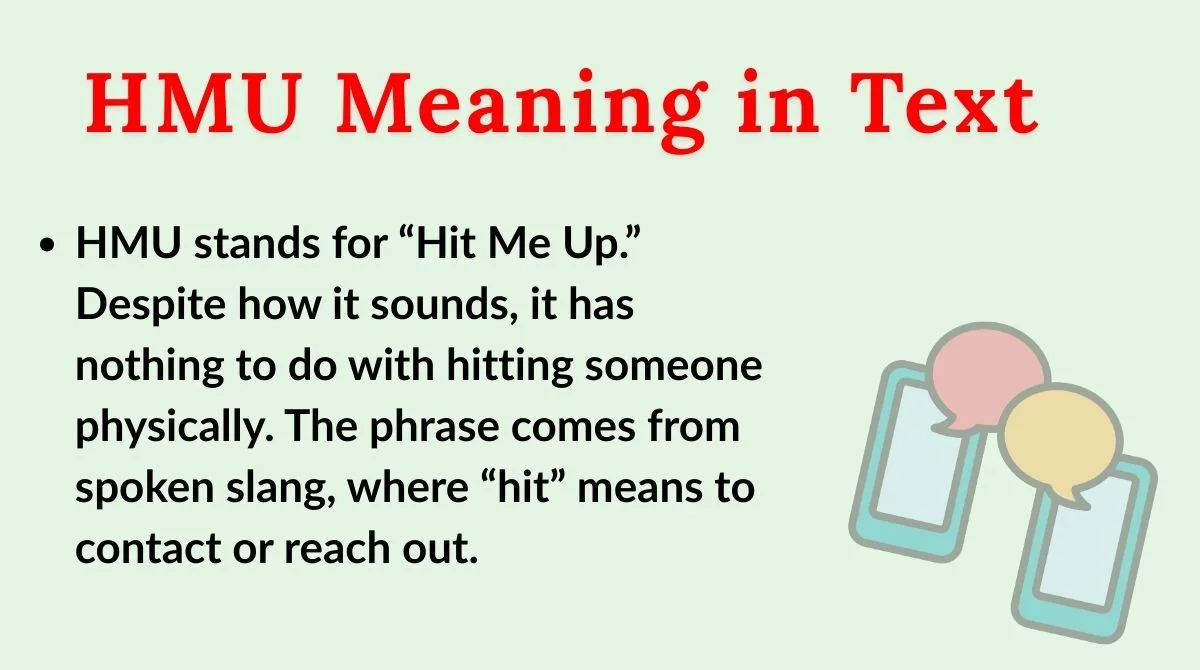
Quick Answer: HMU stands for “Hit Me Up.” It is an informal way of asking someone to contact you, reach out, or get in touch — often used to express interest in hanging out, talking more, or receiving further details.
The Full HMU Meaning — “Hit Me Up” Explained
At its core, the HMU meaning is an invitation. When someone says “HMU,” they are asking another person to contact them — whether by text, call, DM, or any other means. Think of it as the modern-day equivalent of saying “call me,” “drop me a message,” or “let me know.” It’s casual, quick, and universally understood among digital-native generations.
The phrase “hit me up” itself has been part of informal American English for decades, originally meaning to approach someone for something — often money, a favor, or information. Over time, as texting and internet culture evolved, “hit me up” shifted to mean simply “contact me” or “reach out,” and the abbreviated form HMU became the shorthand version used in texts, social media bios, and online chats.
The HMU abbreviation follows the same pattern as many other popular internet acronyms — IMO (in my opinion), TBH (to be honest), LMK (let me know) — where entire phrases get condensed into a few letters for the sake of speed and convenience in digital communication.
“HMU is less about asking for something and more about opening a door — it’s a friendly nudge that says ‘I’m here, let’s connect.'”
How HMU Is Actually Used in Texting and Social Media
Understanding the HMU meaning in text is one thing — but seeing it in action makes it immediately click. The phrase is flexible, and its exact meaning can shift slightly based on context. Here are the most common ways people use it today.
Making Plans to Hang Out
Perhaps the most popular use of HMU is as a casual invitation to socialize. Someone wrapping up a conversation might say “HMU this weekend!” — meaning they’d like to hang out or at least keep the conversation going. It’s relaxed, non-committal, and friendly, which is exactly why it works so well in informal text exchanges.
Example conversation: You: “Hey, haven’t seen you in forever. HMU when you’re free this week!” Friend: “For sure! I’ll HMU Thursday evening, that work?” You: “Perfect 👍”
Expressing Interest in Something or Someone
HMU also appears as a low-key expression of romantic or social interest. On platforms like Instagram or TikTok, someone might post a story saying “single and bored, HMU 😂” — it’s playful, self-aware, and signals openness without being too direct. This usage has become a staple of casual, digital-era flirting.
Sharing Contact Information or Availability
On social media bios, HMU often signals openness to collaboration, networking, or general connection. A freelance designer might have “HMU for projects” in their Twitter bio. A musician might write “HMU for bookings” in their Instagram profile. Here, the HMU meaning functions almost like a call-to-action — an invitation extended to anyone who scrolls by.
Asking for a Recommendation or Tip
Another growing use of HMU is in the context of asking for suggestions. “HMU if you know any good spots in London” or “HMU with your playlist recommendations” are natural, conversational ways to crowdsource information or opinions in a friendly way.
Where Did HMU Come From? A Brief History
Internet slang rarely has a precise origin story, and the HMU acronym is no different. The abbreviation started appearing in online forums and early social networks in the mid-to-late 2000s, picking up speed as SMS texting and platforms like Facebook, Twitter, and later Instagram grew in popularity.
Google Trends data shows that searches for “HMU meaning” spiked notably around 2011 and have remained consistently high ever since — a good indicator of when the term truly entered the mainstream vocabulary. That period coincides with the explosion of casual texting culture, where brevity was prized above all.
By 2012, the Oxford English Dictionary had taken notice of the phrase “hit me up” as a recognized informal expression in American English. While the full phrase has older roots in African American Vernacular English (AAVE) and hip-hop culture, the abbreviated digital version HMU became its own widely adopted form across demographics, age groups, and geographies.
Today, the HMU slang is recognized across generations. It appears in song lyrics, YouTube comment sections, Reddit posts, and even marketing copy aimed at younger audiences — a clear sign of how thoroughly it has embedded itself in everyday language.
Context Matters: Different Shades of HMU Meaning
One of the reasons the HMU meaning has held up so well over time is its contextual flexibility. Depending on who says it, where they say it, and to whom, HMU can carry subtly different tones — and knowing the difference matters.
Friends making plans — “HMU Friday night!” means “let’s hang out” and is completely natural. A social media bio with “HMU for collabs” signals openness to professional inquiries and is perfectly appropriate. A casual flirtatious “You’re cute, HMU 😉” is context-dependent and situational. However, writing “HMU if you need anything” in a formal work email to a client comes across as far too informal and should be avoided. And texting a close contact “HMU if you find tickets” is a perfectly friendly way to say “let me know” or “give me a heads up.”
As these examples show, the tone and appropriateness of HMU hinges almost entirely on the relationship and the setting. Between close friends, it is completely natural. In a semi-professional context — say, messaging a colleague on a work chat app — it might come across as overly breezy. And in formal written communication like a business email, HMU is best left out entirely.
HMU vs. Similar Slang: How It Compares to LMK, TBH, and Others
Part of mastering texting language is understanding how different abbreviations relate to each other. The HMU abbreviation is often confused with or used interchangeably alongside a few other common phrases — but they are not identical.
HMU vs. LMK (Let Me Know)
LMK is perhaps the closest cousin to HMU. Both involve requesting some form of communication, but the direction is slightly different. LMK asks for information or a decision from the other person (“LMK what time works for you”), while HMU is more of an open invitation to reach out in general. Think of LMK as asking for a specific response and HMU as extending a broader welcome.
HMU vs. WYD (What You Doing?)
WYD is a check-in rather than an invitation. Someone asking “WYD?” wants to know your current status or gauge your availability. HMU, by contrast, doesn’t ask for information — it offers an invitation to initiate contact. Often, WYD opens the door, and HMU sets the terms of the ongoing conversation.
HMU vs. IRL (In Real Life)
These two often appear together. “HMU IRL sometime” means “reach out so we can meet in person” — a phrase that lives very comfortably on apps like Bumble BFF or Meetup, where the goal is transitioning from digital connection to actual human interaction.
When You Should Avoid Using HMU
As fluent as you might be in the HMU meaning, knowing when not to use it is equally important. Slang exists on a spectrum of formality, and deploying it in the wrong context can make you look careless or unprofessional.
Avoid using HMU in formal business emails, academic submissions, cover letters, or any written communication where a professional tone is expected. In those cases, phrases like “please feel free to contact me,” “don’t hesitate to reach out,” or “I look forward to hearing from you” are far more appropriate. The same principle applies if you’re messaging someone significantly older who may not be familiar with digital shorthand — clarity always beats cleverness in those situations.
It’s also worth being mindful of cultural context. While HMU slang is widely understood in English-speaking countries and among younger global internet users, it may not translate cleanly for non-native speakers or people less exposed to American internet culture. In those cases, writing out “feel free to message me” or “reach out anytime” is both clearer and more respectful.
Pro Tip: When in doubt about formality, spell it out. “Feel free to reach out” conveys the same warmth as HMU — with zero risk of misinterpretation.
HMU in Pop Culture and Social Media Trends
The staying power of HMU is evident in how thoroughly it has permeated popular culture. From hip-hop lyrics to reality TV show dialogue to marketing campaigns, the phrase has moved well beyond casual texting. Brands targeting Gen Z and Millennial audiences frequently use “HMU” in social media posts to appear approachable, conversational, and in-touch with their audience.
On platforms like TikTok, the HMU meaning takes on new life. Comment sections filled with “HMU if you want the full recipe,” “HMU if you’re also obsessed with this song,” or “HMU your hot takes below” create a sense of community and back-and-forth engagement. It’s participatory language — an invitation to join the conversation rather than just consume it.
Dating apps have also embraced the phrase. Profiles that say “adventurous and spontaneous, HMU if you like hiking and midnight snacks” strike a relaxed, personable tone that formal language simply cannot achieve. The abbreviation signals personality — casual, confident, and approachable.
Other Possible Meanings of HMU
While “hit me up” is overwhelmingly the most common HMU meaning, it’s worth noting that internet acronyms can occasionally have alternative interpretations depending on the community or platform. In certain niche contexts, HMU has also been used to mean “Hook Me Up” — as in, “do me a favor” or “connect me with something.” The shift is subtle but meaningful: “hit me up” is about communication, while “hook me up” is more transactional.
In some online gaming communities, HMU can also loosely mean “help me out” — though this usage is far less widespread and typically context-specific. As with all slang, the best strategy is to read the context rather than assume a fixed definition.
Conclusion
At first glance, the HMU meaning seems simple enough — “hit me up,” a casual request to get in touch. But as this guide has shown, HMU carries far more nuance than those three letters suggest. It’s a social signal, an open invitation, a tone-setter, and a cultural marker all rolled into one compact piece of internet shorthand.
Understanding HMU means understanding how modern communication works: fast, flexible, context-sensitive, and deeply human. Whether you’re using it to make weekend plans with a friend, extend an open invitation on your social media profile, or decode what someone just sent you, knowing what HMU means — and how to use it well — is a small but genuinely useful skill in today’s digital world.
So the next time someone texts you “HMU,” you’ll know exactly what they mean. And if you feel like starting a conversation, don’t hesitate — go ahead and HMU.
Frequently Asked Questions About HMU
Q1. What does HMU stand for in texting?
HMU stands for “Hit Me Up.” It is a casual, informal way of asking someone to contact you — whether by calling, texting, or reaching out on social media. It’s one of the most common texting abbreviations used across all major platforms and age groups among digital users.
Q2. Is HMU used romantically or just for friendship?
Both, depending on context. Between friends, HMU simply means “reach out and let’s connect.” In a romantic context — such as on a dating app or in a flirtatious conversation — it can signal interest in getting to know someone better. The tone and relationship between the people involved usually makes the intent very clear.
Q3. Can I use HMU in a professional or work setting?
Generally, no. HMU is informal slang and is not suitable for formal business emails, professional correspondence, cover letters, or official communication. In a work chat with a close colleague it might be acceptable in a very casual company culture, but it’s safer to use professional alternatives like “please feel free to reach out” or “contact me anytime.”
Q4. Is HMU the same as LMK?
They’re similar but not identical. LMK (“Let Me Know”) typically asks for a specific piece of information or a decision from the other person. HMU (“Hit Me Up”) is a broader, open-ended invitation to initiate contact or communication. You might say “LMK what time works” but “HMU whenever you’re free” — the first asks for a concrete answer, the second simply opens the door.
Q5. Where did HMU originate?
The phrase “hit me up” has roots in informal American English and African American Vernacular English (AAVE), originally meaning to approach someone or ask them for something. The abbreviated digital form HMU gained widespread use in the late 2000s and early 2010s alongside the growth of SMS texting and social media platforms. By 2011–2012, it had become mainstream internet slang recognized globally.

Helping brands improve search visibility through expert guest posting, blogger outreach, quality backlink acquisition, and white-hat off-page SEO strategies that deliver results.