OFC Meaning in Text: What Does OFC Actually Mean?
If you have ever been mid-conversation on WhatsApp, Instagram DMs, or a Discord server and someone fires back with a quick “ofc,” you might have paused for a half-second wondering exactly what they mean. You are not alone. The OFC meaning trips up plenty of people — not because it is complicated, but because internet slang moves fast and not everyone gets the memo at the same time.
The good news? Once you lock in the meaning and the context, you will notice it showing up absolutely everywhere — in texts from friends, replies on Twitter/X, comment sections, work chat apps, and even the odd email from a colleague who is a little too comfortable with abbreviations. This complete guide breaks down everything you need to know about OFC, from its core definition to its tone, context, and the subtle social signals it carries.
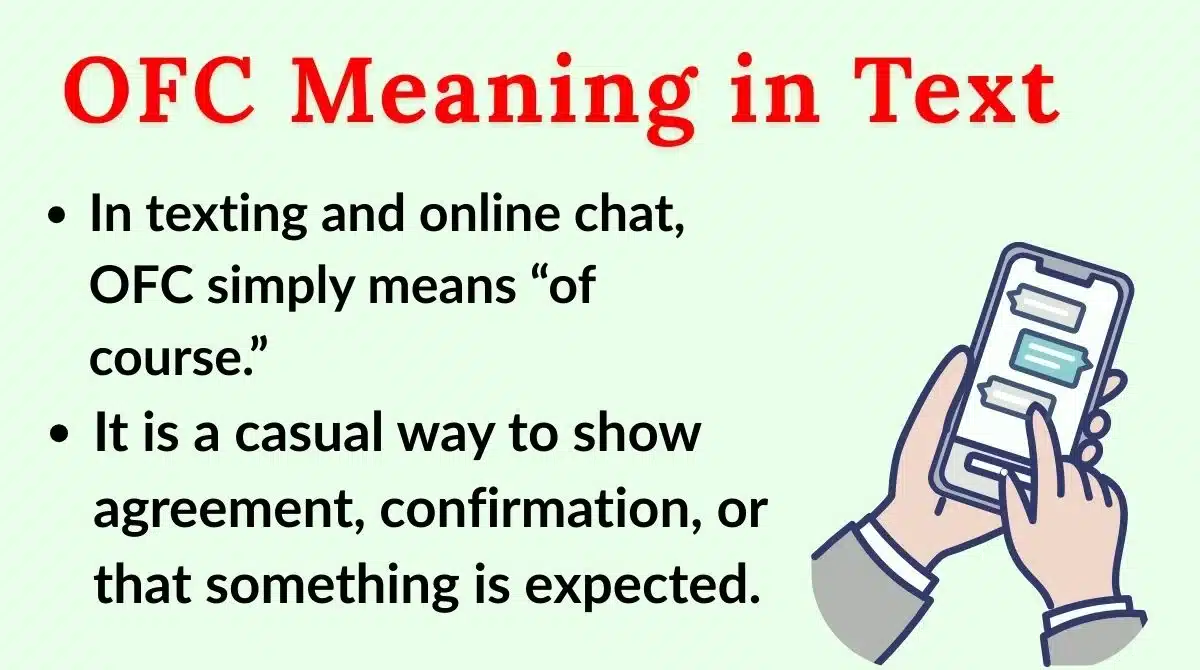
Quick Definition — OFC (abbreviation / adverb): Short for “of course.” Used in texting and online communication to agree with something, confirm information, or emphasize that something is obvious or expected.
What Is the OFC Meaning in Text?
At its most basic, OFC meaning in text is simply a shorthand for “of course.” It is a two-syllable phrase compressed into three letters for speed and convenience. In the digital age, nobody wants to type full phrases when a snappy abbreviation does the same job just as well, if not better.
When someone sends you “ofc,” they are typically doing one of three things: agreeing with you, confirming a request, or pointing out that something should already be obvious. The tone can range from warm and enthusiastic to dry and slightly sarcastic, depending entirely on the conversation’s context.
Think of it as the textual equivalent of a quick nod. If a friend asks, “Are you coming to the party tonight?” and you reply “ofc,” that single word communicates confident, casual agreement without any unnecessary fuss.
The Literal Translation
Breaking it down letter by letter: O stands for “of,” F stands for “for,” and C stands for “course.” Simple, clean, and nearly universally understood among people who spend time in digital spaces. The OFC abbreviation gained traction in the early days of SMS texting when character limits and tiny physical keyboards made brevity a survival skill.
As smartphones took over and typing became faster, many abbreviations faded out. But OFC stuck around because “of course” is genuinely one of the most common phrases in everyday English, and replacing it with three letters feels entirely natural.
How OFC Is Used in Everyday Conversations
Understanding the OFC meaning is step one. But the real skill is knowing how to read the tone behind it, because “of course” can mean very different things depending on how and where it lands in a conversation.
Casual Affirmation
The most common use of OFC is as a simple, friendly agreement. Someone asks you a question, and you want to say yes without any hesitation or ceremony. For example: “Hey, can I call you later tonight?” — “ofc! I’ll be home by 8.”
In this case, OFC works like a friendly, relaxed “yes, absolutely.” Adding an exclamation mark after it (ofc!) ramps up the warmth and enthusiasm. It signals not just agreement but genuine willingness.
Confirming Something Expected
Another widespread use of the OFC acronym is to confirm something the other person already suspects or expects to be true. Here, it carries a hint of “did you even need to ask?” For example: “Did you already check the weather before planning the hike?” — “ofc I did, we’re good to go.”
This usage communicates competence and preparedness. It slightly implies that the confirmation was barely necessary — of course the speaker checked the weather.
Sarcastic or Dry Tone
Like many short responses in text, OFC can take on a completely different flavor when used sarcastically. Context is everything. If someone describes a frustrating situation and you reply “ofc” without any warmth or follow-up, it can read as resigned, eye-rolling acceptance — like saying “of course that happened” about something predictably bad. For example: “The Wi-Fi went out again right as my Zoom call started.” — “ofc it did. Classic.”
Here, the OFC meaning shifts from eager agreement to weary, ironic acknowledgment. Pay close attention to surrounding language whenever you are unsure which register someone is using.
OFC Variations and Related Slang
The internet never stops remixing language, and OFC is no exception. Once you understand the core OFC meaning, you will also start noticing its variations and closely related expressions.
Capitalization and Punctuation Matter
Lowercase “ofc” is the standard, casual form — relaxed and conversational. Uppercase “OFC” can feel more emphatic depending on context, similar to how typing in all caps generally implies raised volume. “OFC!!” with multiple exclamation marks amplifies enthusiasm. “ofc…” with an ellipsis tends to sound tired, reluctant, or passive-aggressive.
Small punctuation choices pack a punch in digital communication. Texting someone “ofc I love you” reads entirely differently from “ofc I love you…” — the first is warm and certain; the second could raise a concern or two.
Related Abbreviations in the Same Family
A few related shorthand phrases tend to show up alongside OFC. “Obv” or “obvs” — short for “obviously” — is used in much the same way when something feels self-evident. “NGL” (not gonna lie) often pairs with OFC when someone is being candid and emphatic. “TBH” (to be honest) creates a similar confessional, candid vibe. And “FR” (for real) amplifies sincerity, making “ofc fr” a particularly emphatic agreement — something like “yes, absolutely, I mean it.”
OFC Across Different Digital Platforms
The beauty of the OFC meaning is that it travels well across every platform. Whether you are on a professional workspace app or a meme-heavy Discord server, ofc fits in with minimal adjustment — though context always shapes how it lands.
Texting and WhatsApp
This is where OFC feels most at home. In personal messaging apps, the slang is fully accepted and understood. Conversations between friends, family, and romantic partners frequently feature ofc as a quick, low-effort way to say yes, agree, or confirm. In group chats especially, where messages pile up fast, short replies like ofc keep the momentum going.
Twitter/X, Instagram, and TikTok
On social media, OFC shows up frequently in comment sections and replies. When a creator posts something and a fan comments “ofc you’d be amazing at this,” it functions as an enthusiastic compliment. On TikTok, where comment responses are often short and punchy, ofc serves as quick social validation — a subtle badge of belonging in internet culture.
Discord and Gaming Communities
In gaming and hobby communities where chat moves at the speed of play, brevity is not just polite — it is necessary. “Can I join your squad?” — “ofc man, hop in.” Clean, fast, friendly. No wasted keystrokes.
Professional Messaging (Slack, Teams)
This is where things get nuanced. The OFC meaning is widely understood among younger professionals, and it has started creeping into workplace chat apps. In a casual internal Slack channel between colleagues of similar seniority and age, “ofc” is perfectly fine. In a client-facing message or a formal work email, it is better left out entirely.
The Origins and Evolution of OFC
Like most texting abbreviations, OFC emerged from the practical constraints of early mobile communication. In the early-to-mid 2000s, texting on a numeric keypad was slow and sometimes had per-character costs. Abbreviations were a matter of economy. Phrases like “lol,” “brb,” “omg,” and “ofc” became second nature to a generation that grew up navigating T9 keyboards and AIM instant messaging.
As communication platforms matured — from SMS to BlackBerry Messenger to smartphone apps — many slang terms evolved or disappeared. But OFC endured because the phrase it represents is too useful and too frequent to abandon. Unlike some slang that is era-specific, OFC translates cleanly across generational lines. A teenager and a 35-year-old professional can both use it without it sounding out of place — which is rare in the world of digital shorthand.
Linguists who study internet language note that abbreviations like OFC are not signs of laziness but evidence of a living, evolving language system. They carry emotional tone, social context, and shared cultural knowledge — far more than their letter count suggests.
When Should You Avoid Using OFC?
Knowing the OFC meaning is helpful; knowing when NOT to use it is equally important. Like all informal language, context determines appropriateness.
Avoid OFC in formal written communication — academic papers, official emails to superiors or clients, legal documents, or any context where a professional tone is expected. Using it there signals either a lack of awareness or poor judgment.
Be cautious when using OFC sarcastically with people who do not know you well. Without vocal tone or facial expressions to guide interpretation, a dry “ofc” can easily read as dismissive or rude when the sender meant it as a knowing joke. When in doubt, add a clarifying word or emoji to smooth the tone.
And finally, if you are communicating with someone significantly older or less familiar with internet culture, spelling out “of course” is always the safer and more respectful choice. Clarity beats coolness when the stakes matter.
OFC in Memes, Pop Culture, and Online Humor
One of the most charming things about the OFC abbreviation is how naturally it has woven itself into internet humor. Meme culture thrives on compressed language, and “ofc” slots perfectly into reaction memes, ironic commentary, and self-aware humor.
You will frequently see it used in meme captions where the humor relies on acknowledging something painfully predictable — “the Wi-Fi goes out during the most important scene, ofc” — or as a punchline to self-deprecating jokes. On platforms like Twitter/X, the sarcastic deployment of OFC has become a recognizable comedic shorthand: a way of shrugging at life’s absurdities with knowing wit.
Social media influencers and content creators use it as a rapport-building tool too. Responding to fan comments with “ofc!!” feels warm, spontaneous, and relatable — far more than a formal “certainly!” would in that context.
OFC vs. Similar Slang: How It Compares
It is worth situating the OFC meaning alongside similar expressions to appreciate what makes it unique and when alternatives might serve you better.
“Sure” is less emphatic than OFC — it suggests willingness but not necessarily enthusiasm. “Yeah” is equally casual but carries less of the “this should be obvious” connotation. “Absolutely” is more formal and carries more weight, but lacks the breezy, modern feel of ofc. “Obv” (obviously) is the closest sibling — used when something is self-evident — but it can come across as slightly more condescending than ofc if misused.
OFC hits a sweet spot: it is confident, friendly, modern, and versatile. It says “yes” while quietly communicating that the speaker is at ease, socially fluent, and quick on their conversational feet.
Final Thoughts: The OFC Meaning, Unpacked
At the end of the day, the OFC meaning is wonderfully simple: it is “of course,” trimmed down to three fast, punchy letters. But like all great shorthand, its simplicity is deceptive. OFC carries tone, context, cultural awareness, and social nuance depending on where it appears, how it is capitalized, and what surrounds it.
Mastering its use means understanding not just the literal definition but the range of registers it can occupy — from warm and enthusiastic to dry and sarcastic. It means knowing when to deploy it and when to leave it out. And it means appreciating it as part of a broader, living language that continues to evolve in real time across millions of conversations every day.
Whether you have been using ofc for years or just encountered it for the first time today, you are now fully equipped to use it with confidence, read it accurately, and understand the subtle social signals it carries. Ofc, that is exactly why you came here.
FAQs
OFC stands for “of course.” It is one of the most widely used texting abbreviations in English-language digital communication and is used to agree, confirm, or emphasize that something is obvious or expected. It is common on platforms like WhatsApp, Instagram, Twitter/X, Discord, and Snapchat.
Yes, absolutely. While OFC is most often used as a genuine and friendly affirmation, it can carry a sarcastic or dry tone depending on context. When used to acknowledge something predictably bad — like “ofc the bus was late” — it functions as resigned, ironic commentary rather than enthusiastic agreement. The surrounding text and punctuation usually make the intended tone clear.
It depends on the workplace culture and the specific communication channel. In casual internal Slack or Teams chats among colleagues who share a similar communication style, OFC is generally acceptable. However, it should be avoided in formal emails, client-facing messages, or any communication where a professional tone is expected. When in doubt, write out “of course” in full.
Both OFC (of course) and “obv” (obviously) are used to confirm or emphasize something self-evident, but they carry slightly different tones. OFC is warmer and more agreeable — it often functions as a positive confirmation. “Obv” can sound slightly more dismissive or condescending, especially when indicating that something should have been known already. OFC is the safer, friendlier choice in most situations.
OFC gained widespread use in the early-to-mid 2000s during the era of SMS texting and instant messaging platforms like AIM. The abbreviation thrived because typing on early mobile keyboards was slow and sometimes costly per character. OFC endured because “of course” is one of the most frequently used phrases in everyday English conversation, making its shortened form genuinely useful across every generation of digital communicators.
What Does RCS Mean in Text Messages? Explained

Helping brands improve search visibility through expert guest posting, blogger outreach, quality backlink acquisition, and white-hat off-page SEO strategies that deliver results.